

Rep Login  

How To: Passivation for Stainless Steel Vessels

How To: Passivation for Stainless Steel Vessels How To: Passivation for Stainless Steel Vessels How To: Passivation for Stainless Steel Vessels How To: Passivation for Stainless Steel Vessels


Rapid data center expansion and modern HVAC demands have led more engineers and specifiers to choose stainless steel vessels for their systems. But what exactly is passivation, and what makes a passivated stainless steel vessel desirable over traditional carbon steel?

What is Passivation?

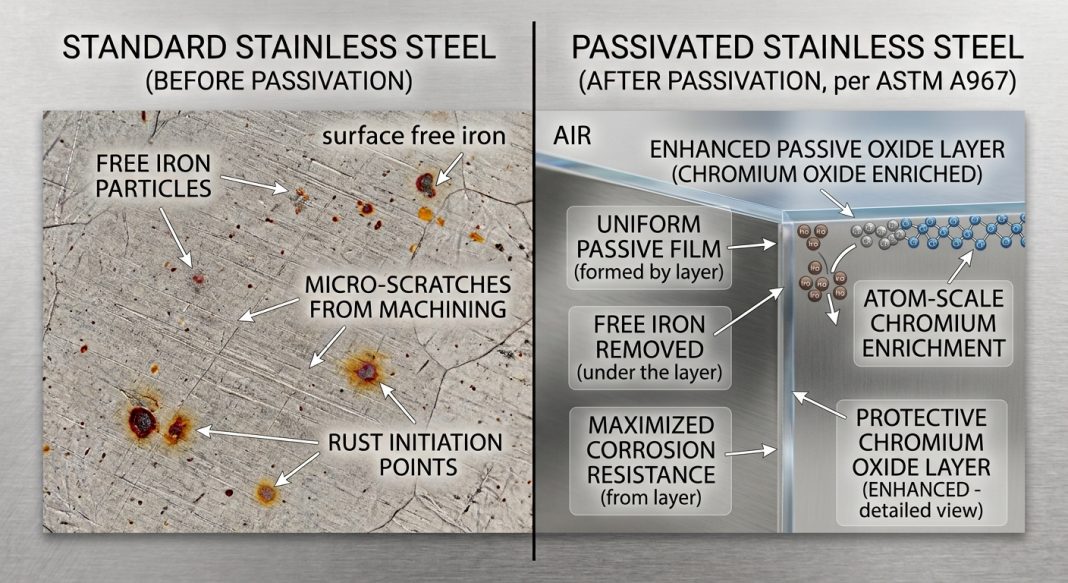
Passivation is a multi-step chemical finishing process performed after components are manufactured, welded, and assembled. Its primary goal is to maximize the steel’s natural corrosion resistance.

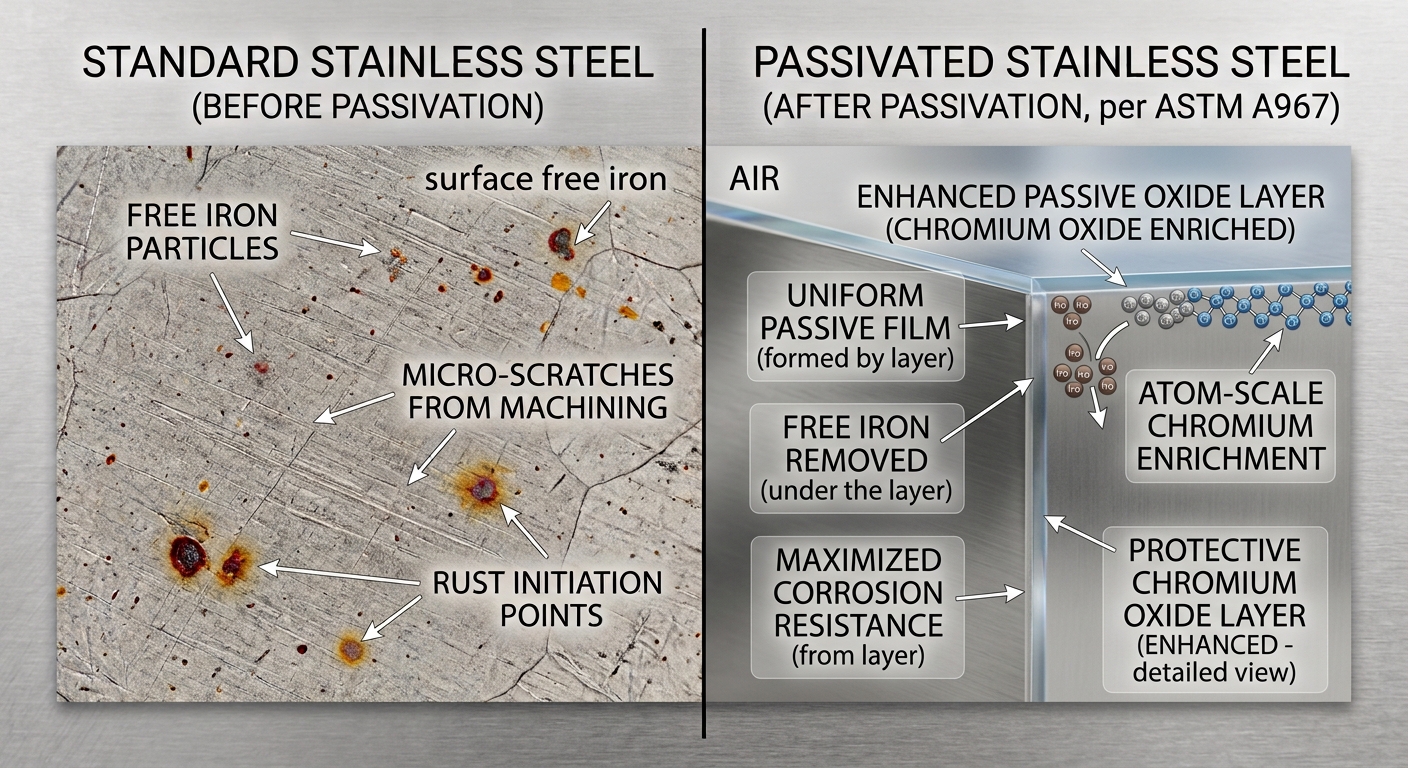
There is a common misconception that passivation physically fills surface flaws or mechanically alters the strength of the metal. In reality, it works chemically: during fabrication processes like cutting, machining, and welding, microscopic traces of free iron (tramp metal) from tooling get embedded into the steel’s surface. If left untreated, these iron particles react with air and moisture, triggering localized rust, pitting, and long-term surface deterioration.

Passivation removes these iron contaminants, allowing the stainless steel to protect itself as intended.

How Passivation Works: Building the Oxide Layer

Stainless steel owes its corrosion resistance to chromium ( of the alloy). When an acid bath selectively dissolves surface iron, it exposes an enriched concentration of chromium underneath.

Once rinsed and exposed to ambient air, this chromium rapidly reacts with oxygen to form an imperceptibly thin, continuous, and self-healing chromium oxide passive layer. This layer acts as a permanent barrier between the raw steel and the surrounding environment, keeping moisture and corrosive agents out.

Choosing the Acid Chemistry: Nitric vs. Citric

Passivation typically relies on one of two acid types:

The 4-Step Passivation Process

Achieving a true passive finish requires a tightly controlled sequence:

  1. Pre-Cleaning & Degreasing: Oils, machining coolants, and shop dirt are washed away. Acid cannot dissolve free iron if organic residues block direct contact with the metal.
  2. Acid Bath Immersion: The vessel is submerged in a controlled nitric or citric acid bath to dissolve free iron and surface contaminants.
  3. High-Purity Rinsing: The part is thoroughly rinsed with clean water to flush away acid residue and prevent chemical staining.
  4. Air Drying & Passive Layer Formation: As the vessel air-dries, exposed surface chromium reacts with ambient oxygen to form the protective chromium oxide film.

Why Passivation Is Exclusive to Stainless Steel

Passivation can only be performed on stainless steel and compatible high-chromium alloys. Carbon steel lacks the chromium required to build a protective oxide layer. If you submerge carbon steel into a passivating acid bath, the acid will aggressively etch and eat through the raw iron, weakening the vessel rather than protecting it. Carbon steel must instead rely on internal coatings, linings, or chemical system inhibitors for corrosion protection.

Stainless Steel Solutions from Wessels Company

By removing surface contaminants and enabling full passive oxide film growth, passivation ensures stainless steel vessels stand up to the most strenuous and harsh operating conditions.

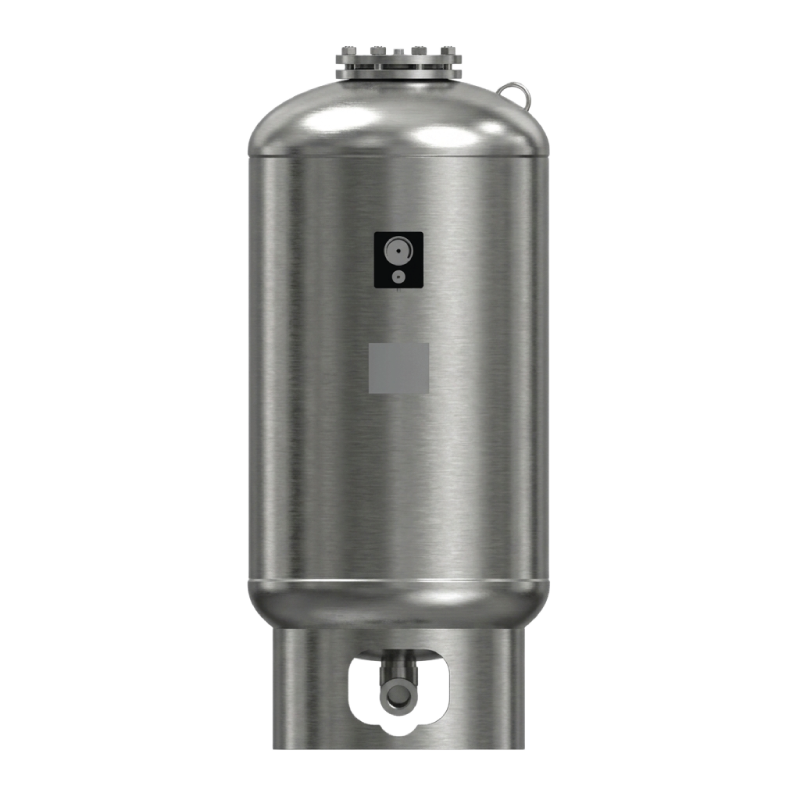
Wessels Company offers passivation options across our stainless-steel product lines, including expansion tanks, thermal energy storage vessels, and air-dirt separators. In addition, some sourcing partners offer ferrous-free facilities to prevent cross-contamination. For more information on custom stainless steel vessel options or to request a quote, visit westank.com or call our headquarters at 317-888-9800.

Full width regal divider
How To: Retrofit Your Tank with WessGuard
How To: Retrofit Your Tank with WessGuard

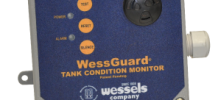
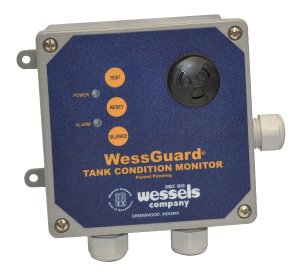
Wessels Company’s patented WessGuard® system is the industry’s first sentry for critical mechanical system protection. Mechanical systems are expensive to install and potentially more costly to service or replace. WessGuard® acts to protect the critical components of the mechanical system by monitoring the effectiveness of the system expansion tank. WessGuard® can be installed in new installations or retrofit to many of the vessels installed today.

Wessels WessGuard® system can be retrofitted to nearly any removeable bladder-style expansion tank. The system monitors the fluid within expansion tanks by determining excessive movement of the vessel bladder. It incorporates a capacitive proximity sensor that determines if fluid levels in the expansion tank exceed “normal” operating conditions. If a tank bladder is compromised, the WessGuard® monitors the rising fluid level in the tank. The monitor alerts users of the potentially unsafe conditions by activating an audible alarm and includes a set of dry contacts to tie directly to an energy management system.

How would a retrofitted WessGuard® benefit your tank and overall system? If a tank in the system has a compromised bladder and the user is not sure why, a WessGuard® may help determine the cause. It also provides maintenance an added level of protection by serving as an early warning system.

If you suspect your tank has a compromised bladder and a pressure test has revealed no issues, the WessGuard® will be able to help the user to determine if a power surge is causing the system to receive no power or if the bladder is overfilling.

For maintenance or for replacing a bladder, be sure to check the inside of the tank to make sure there aren’t any rusted sharp points that may cause a bladder to be punctured.

Any tank that has been manufactured by Wessels, whether it is 12 years old, or 12 minutes after it’s been shipped to its destination, can be retrofitted to add a WessGuard®. However, if the tank is more than 18 months old, the WessGuard® will have to be custom made.
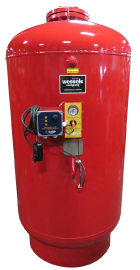
In newer model tanks, made since the beginning of 2018, a WessGuard® can simply be added to the prefab bracket on the side of the tank and screwed into the pre-existing spud where the WessView® is currently located.

The update itself takes about 5 minutes to complete. However, the tank will have to be taken off-line, decompressed, and then recompressed after the WessGuard® is added to the outside of the tank and then returned to the system. This sensor is shielded and has a metal casing around it that helps to protect the face of the sensor.

With the new style WessGuard®, in the new style tanks, every tank and sensor are set up and installed the same way. But with the previous-style tanks and the original WessGuard® design, every tank that receives a retrofit must be done to fit each specific tank. In order to install a WessGuard® in a previous-tank, our quality control supervisor will measure the length of the cord needed for the sensor to hang internally and monitor the volume of the tank.

With the previous-style tanks, there is a one-inch spud at the top of the NLA and FXA 1000 and above. The WessGuard® monitor goes in and will be dropped down until it gets to about 60% of the tank volume. This sensor is not shielded, but it does have bumper rings around it to keep it from getting a false positive.

The cord for the newly installed WessGuard® on a previous-style tank is surrounded by a pressure fitting, so the tighter the fitting is installed, the better the pressure is held inside the tank. The one-inch stainless steel fitting has a gasket inside of it, which the cord for the sensor is threaded through and a nut on the inside. Once the nut is tightened, the gasket and cord are tightened and help the pressure stay inside the tank.

When retrofitting a WessGuard® to a newer style tank, the sensor replaces the WessView®. However, in the older style tanks, because the WessView® was formerly optional, the WessGuard® goes in from the top and not a pre-existing plug. Because with the older style tank, there is no pre-fab box to attach the WessGuard® to, it comes with an epoxy which is used to attach the WessGuard® box on the outside of the tank.

Using air that is too moist to fill the tank could potentially affect the monitor and may give a false positive. It is important to make sure when filling the tank, the air being used must not be too wet.

Retrofitting or purchasing a WessGuard® for your system is always a good idea and adds an extra layer of protection to your tank, bladder and overall system. The WessGuard® can give your maintenance a little piece of mind, knowing an issue with the bladder will be signaled sooner than later.

If you would like to purchase a WessGuard® with your next tank order, or if you would like to have a WessGuard® retrofitted to a previous-style tank, you can visit our website at westank.com or you can call our office to inquire about retrofitting an older style tank.

July Employee Spotlight

July Employee Spotlight

Chanel Warner is an administrative assistant and front-desk receptionist at Wessels Company’s headquarters and is coming up on her 1 year anniversary in the position. Chanel enjoys styling hair in her spare time. She also enjoys dogs and shopping, but dislikes cats and toxic behavior.

Chanel’s fast facts:

Favorite Color: Purple
Likes: Dogs, Shopping
Dislikes: Cats, Toxic People
Hobbies: Hair Styling and Fashionable Clothes
Nickname: Nelly

Chanel Warner
Administrative Assistant
e-mail: [email protected]
phone: 317-888-9800

June Employee Spotlight

June Employee Spotlight

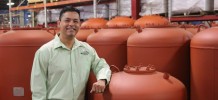
Frank Rios is regional sales manager and a technical support agent who has worked with Wessels for over 9 years. Frank’s career began in the Navy and he later attended Ivy Tech to pursue a career in Business Management. He enjoys running, playing golf, basketball, and target shooting. When he’s not at work, he enjoys rooting for the Boston Celtics and the Denver Broncos. Frank is also very passionate about his family, friends, and work ethic.



Frank’s fast facts:

Favorite Color: Green
Favorite food: Steak
Likes: Traveling, basketball, golf, and target shooting
Dislikes: Liver, so don’t even ask!
Fun fact: Learned English age 12

Frank Rios
Regional Sales Mgr. / Support
e-mail: [email protected]
phone: 317-888-9800
cell: 317-696-1487

Wessels Product Certifications from Around the World

Wessels Product Certifications from Around the World

Wessels Company manufactures and ships pressure vessels and HVAC specialty equipment all over the world, which means products must pass rigorous testing to meet a variety of international certifications.

Wessels is primarily known as an ASME shop. ASME is short for The American Society of Mechanical Engineers and is a professional organization that sets technical guidelines for mechanical manufacturers, engineers, designers and equipment operators. The ASME certification signifies stronger fabrication standards and overall operation reliability.

There are various divisions to ASME coding, but Wessels manufactures specifically to section VIII division 1. For a vessel to qualify for certification, the manufacturer must pass an on-site certification process which is monitored and approved by an ASME inspector.

Wessels typically builds to “U” stamp because it’s all-inclusive of everything we can build to Section VIII. The “UM” stamp stands for “miniature vessels,” and is only valid for pressure vessels of a certain size.
Wessels also has the ability to build to a “UM” stamp if this would be required. “UM” is also self-certifying, so there is no involvement from the third party inspection agency for certifying “UM” vessels. In some cases it is preferred to have “UM” models made. However, there’s nothing that you can build in “UM” that you can’t also build with a “U” stamp.

Other international certifications are country-specific, such as the JIS and the CRN in Japan and Canada respectively. JIS is short for Japanese Industrial Standard and it signals to users that the reliability of the product has been met to the satisfaction of the Japanese Industrial Standards Committee.

The CRN stands for Canadian Registration Number and designates the design and use of pressure vessels, piping systems, and system fittings. The CRN certification is required for each product used within a system and ensures the fabrication, inspection, and registration of each product with the National Board. Any product design that is intended for use in Canada is reviewed multiple times and must be approved in all the jurisdictions within Canada where the product may be used.

The DOSH certification, which is an abbreviation for Department of Occupational Safety and Health, is from Malaysia. Wessels products that are covered under the DOSH certification include expansion tanks, heat exchangers, and pressure vessels. Manufacturers who import these items into Malaysia must be certified by a third-party inspection agency.

For vessels used in Singapore, the certification is called MOM or Singapore Ministry of Manpower. Before pressure vessels are to be used in Singapore, the Director of Occupational Safety of their approved representative needs to approve the manufacturers process in fabrication and a report needs to be issued and accepted by an overseas inspection agency. For vessels in India, the IBR or Indian Boiler Regulation certifies fabrication and materials used in pressure vessels. 

The Pressure Equipment Directive, or PED, sets the standard for design and fabrication of pressure vessels for countries in the European Union. This certification ensures products conform to Pressure Equipment Regulations within the safety standards set in the EU.

In Australia, the AS1210 certification ensures that products meet the minimum standards for materials, design, manufacture, testing, inspection, certification and documentation requirements set by the Australian Standards for pressure vessels operated within the country. This standard specifies requirements for metallic and non-metallic vessels, or metallic vessels with non-metallic linings. This requirement is certified by inspections during various stages of the life of the vessel and it notes that the quality or other standards are met that may be relevant to the product.

Finally, Wessels Company’s liquid to liquid plate and frame heat exchangers are certified by the AHRI Standard 400. This certification ensures products meet and operate as intended and is attained after the product has been tested in a lab by third party inspection. The 400 standard means WesPlate heat exchangers meet safety, energy efficiency, and toleration level requirements set for the product by individual states and the government of the United States.

May Employee Spotlight

May Employee Spotlight

Grace Cramer is one of the new smiling faces in our Engineering Department. Grace holds the role of Product Design Engineer and has been with Wessels for 6 months. She enjoys traveling, cats, and playing board games, and she can even be found coding her own video games in her spare time.  Grace likes to root for her alma mater, Purdue, and she also watches the Colts during football season.

Grace’s fast facts:

Favorite Color: Purple
Favorite food: Pasta
Likes: Video games, cats, hot tea, and traveling
Dislikes: Cold weather, peanut butter, needles  
Fun fact: She’s a pescatarian

Grace Cramer
Product Engineer
e-mail: [email protected]
phone: 317-888-9800

Wessels Employee Wins Student Achievement Award

Wessels Employee Wins Student Achievement Award

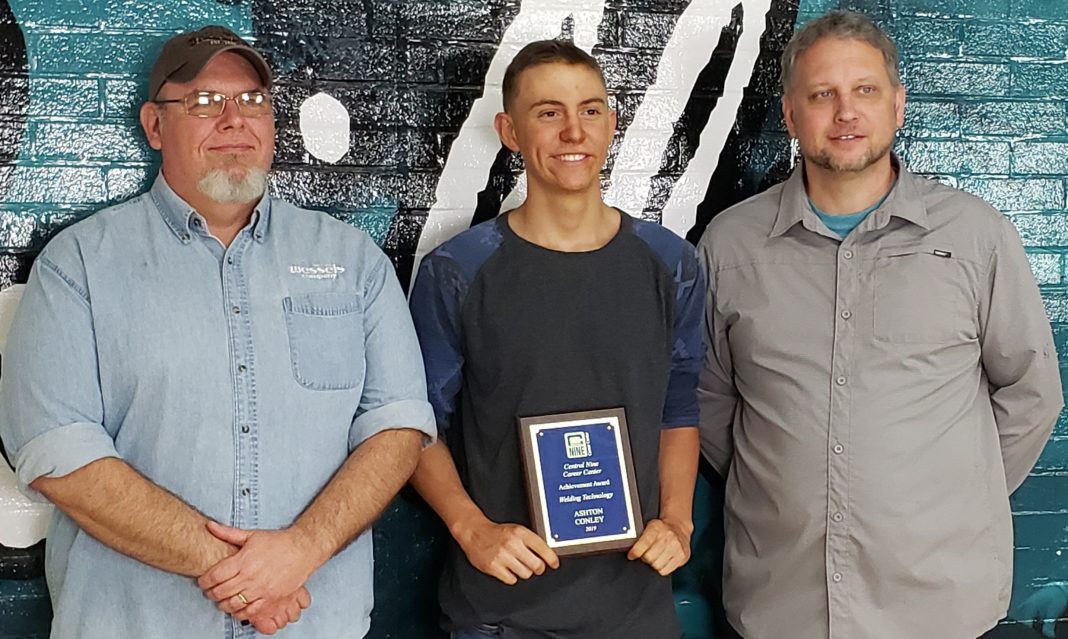
Wessels Company’s student employee, Ashton Conley, has Won the Student Achievement Award from Central Nine Career Center in Welding Technology.

The Achievement Award is given to an outstanding Central Nine Career Center senior who is in the second year of their program and has exhibited outstanding work, good attendance, is a good citizen and has shown outstanding work ethic in the classroom and lab.  Only one award is given in each program and Ashton earned the award within in the Welding Technology program.

Welding instructor Jason Wiley recalls, “The second year I got him, unfortunately he had some problems at home I didn’t realize, and it turned out, you know, his house burned down.”

But Wiley says, he didn’t let his issues at home stop him from
excelling.

“I thought right to myself right then, this guy is good enough to go out already, he’s worked hard enough he can do it, so I called Bob and Wessels is here to honor him,” Wiley said.  “That’s how much they think about him there, and they gave him a job and the next thing you know, I’m seeing Bob and he’s telling me what a great guy (Ashton) is and how hard he works.”

“He’s a hard worker,” Bob says. “I’m happy he was selected
for this award.”

Ashton has worked at Wessels since September 2018 and plans to attend Hobart Welding Technology Institute in October to attain more welding certifications.

Wessels Company proudly congratulates Ashton Conley on earning this award.

Seeing Green with Water-Side Economizing and Free Cooling

Seeing Green with Water-Side Economizing and Free Cooling

Happy Earth Day! New requirements to repair and upgrade existing buildings and infrastructure in an effort to lower emissions and improve energy efficiency means greener energy for the planet and an opportunity to see green as HVAC equipment providers.

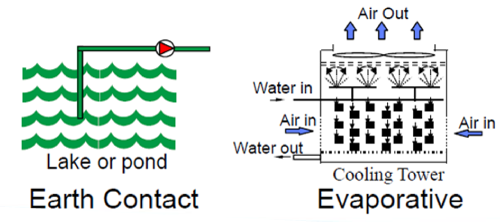
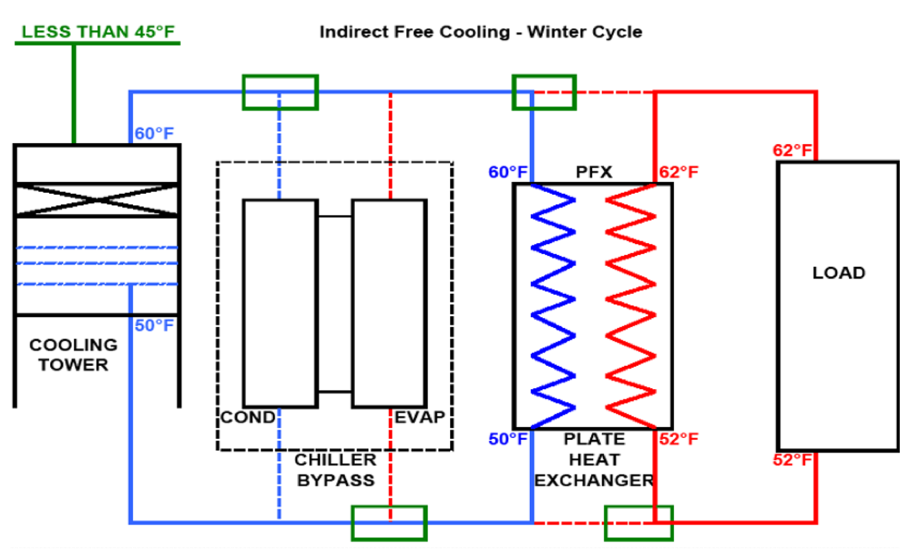
ASHRAE Standard 90.1 requires water-side economizers on almost all chiller installations in North America to reduce the high cost of running refrigerant compressors when making chilled water for commercial buildings. The water-side economizer cools or partially cools the chilled water loop with alternate sources to reduce electric consumption and save energy and money. The economizer takes the heat from the building chilled water loop to earth contact groundwater or to the air though an evaporative cooling tower.

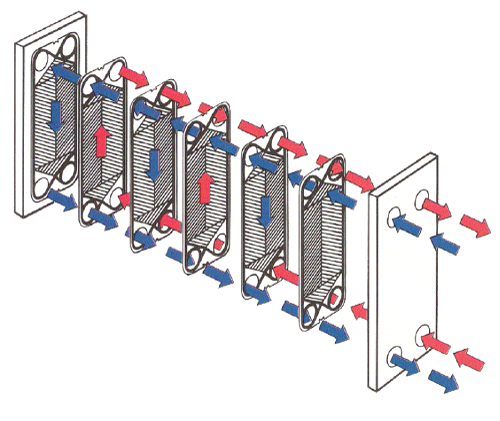
The WesPlate plate and frame heat exchanger is the perfect water-side economizer. It consists of specially corrugated metal plates that maximize heat transfer. Gaskets are fixed between the plates to contain and separate two fluids. These fluids flow alternately between every other plate, counterflowing to produce the greatest rate of heat transfer and provide the closest temperature approach to the incoming cooling tower or ground water. The special surface of the heat transfer plates provides a highly turbulent flow that scrubs the plates clean to reduce fouling and creates the highest rates of heat transfer possible.

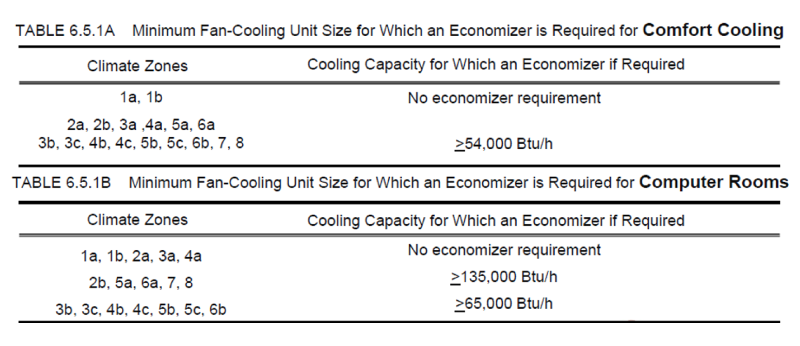
ASHRAE Standards are the specifications for engineers designing HVAC systems in North America. For ASHRAE 90.1 Energy Standard, the following requirement has been added:

6.5.1 Economizers. Each cooling system that has a fan shall include either an air or water economizer meeting the requirements of Sections 6.5.1.1 through 6.5.1.4

ASHRAE 90.1

Engineers are required to add water-side economizing plate heat exchangers to almost all of their building designs. Because the efficiency of water-side economizers is limited by climate, ASHRAE has broken the US up in to climate zones.

How does it work? When a building requires about 500 tons or more for cooling purposes you go from an air-cooled refrigerant condenser in the air conditioner to a water-cooled condenser in the chiller. With water-cooled, there is typically a cooling tower or ground contact heat sink to move the heat from the building to the outside. A plate heat exchanger water-side economizer can be added to do some or all of the heat removal required by the building.

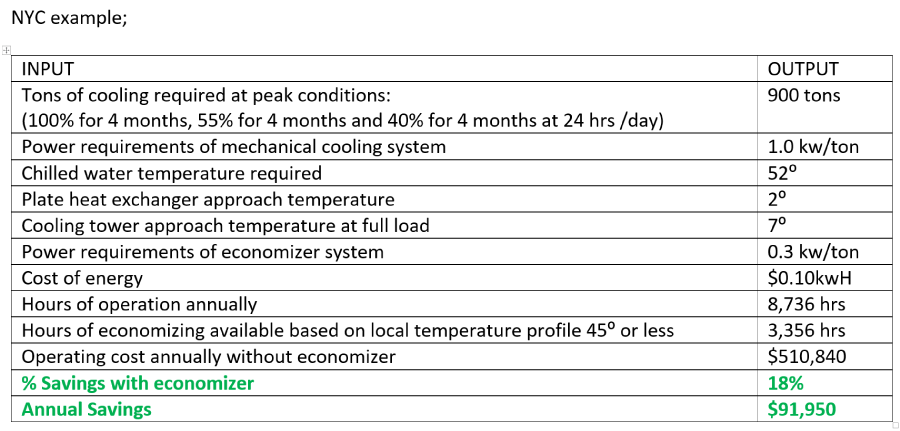
Economics. The savings of using a water-side economizer vary based on climate conditions at the location and how much chilled water is needed year-round. Installations with data centers require year-round cooling. An older mechanical/compressor system may operate as high as 1 kw/ton of refrigeration produced, while a system with a water-side economizer installed may operate as low as 0.3 kw/ton. So the savings can be calculated by taking the difference in operating cost between the full mechanical system and the costs when the water-side economizer is operating.

Example: NYC. A water-side economizer using a cooling tower typically works best when the temperature outside is down to 45⁰. So to calculate the savings of a system we must get a temperature profile of the region to see how often the water-side economizer will be running.

Seeing Green: The only way to guarantee savings and performance is to use AHRI Standard 400 certified plate heat exchangers like the WesPlate from Wessels Company.  Wessels heat exchangers go through rigorous testing to be certified. ASHRAE 90.1 requires heat exchangers be AHRI certified and listed at www.ahridirectory.org.

For more information, check out https://www.westank.com/heat-exchangers/

April Employee Spotlight

April Employee Spotlight

April Employee Spotlight

Margaret Chojnacki is a Wessels Company Vice President and the Western Regional Sales Manager.  Margaret is the employee who has been with the company the longest, at 25 years and has been in her current position for over six.  She lives and works in Hawaii where she enjoys spending time with her family as well as swimming, SCUBA diving and sailing.  Margaret and her husband Don, who also works for Wessels, have 7 children, 7 grandchildren, and one great-granddaughter.

Margaret fast facts:

Employee
with the most longevity with the company at 25 years

Enjoys
living in Hawaii

Favorite
food: multi-cultural vegetarian cuisine                                               

Hobbies: hiking, cooking, custom
dress making