
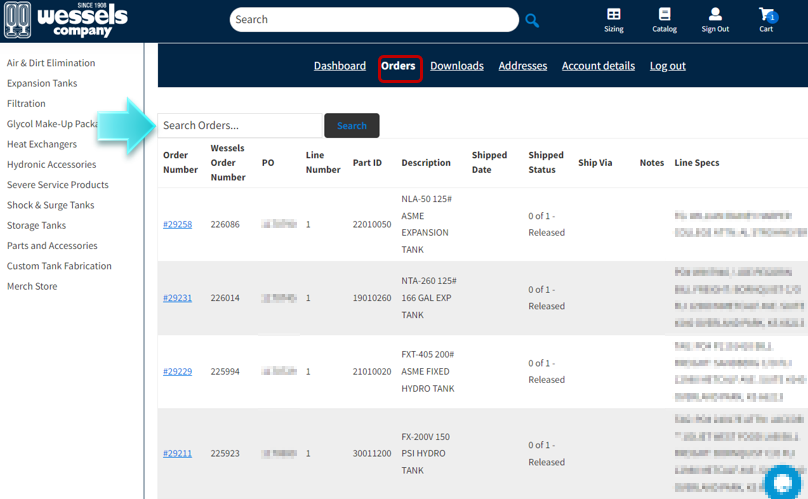
New! Online Order Search Bar
|
|
|
|
|


Rapid data center expansion and modern HVAC demands have led more engineers and specifiers to choose stainless steel vessels for their systems. But what exactly is passivation, and what makes a passivated stainless steel vessel desirable over traditional carbon steel?
What is Passivation?
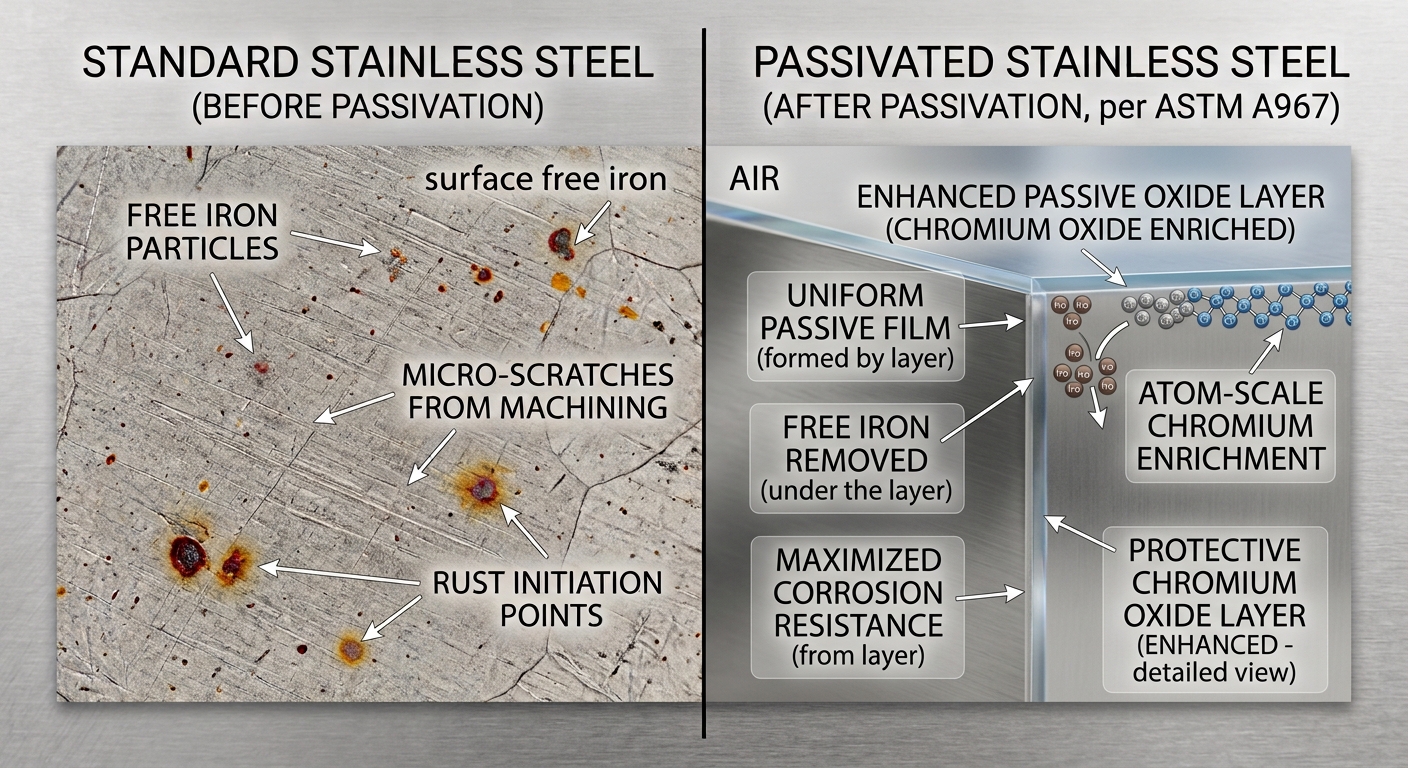
Passivation is a multi-step chemical finishing process performed after components are manufactured, welded, and assembled. Its primary goal is to maximize the steel’s natural corrosion resistance.
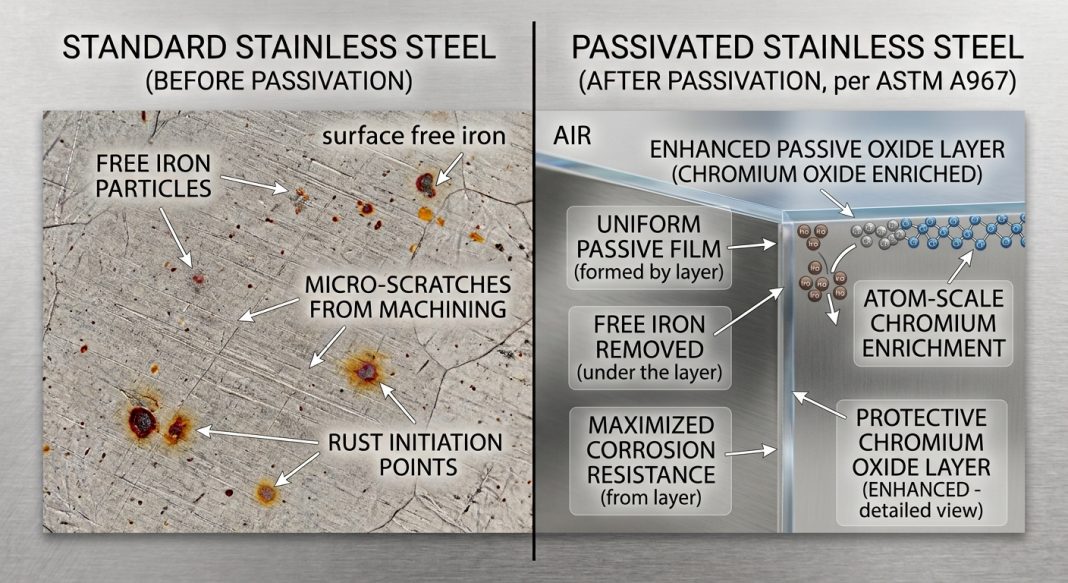
There is a common misconception that passivation physically fills surface flaws or mechanically alters the strength of the metal. In reality, it works chemically: during fabrication processes like cutting, machining, and welding, microscopic traces of free iron (tramp metal) from tooling get embedded into the steel’s surface. If left untreated, these iron particles react with air and moisture, triggering localized rust, pitting, and long-term surface deterioration.
Passivation removes these iron contaminants, allowing the stainless steel to protect itself as intended.
How Passivation Works: Building the Oxide Layer
Stainless steel owes its corrosion resistance to chromium ( of the alloy). When an acid bath selectively dissolves surface iron, it exposes an enriched concentration of chromium underneath.
Once rinsed and exposed to ambient air, this chromium rapidly reacts with oxygen to form an imperceptibly thin, continuous, and self-healing chromium oxide passive layer. This layer acts as a permanent barrier between the raw steel and the surrounding environment, keeping moisture and corrosive agents out.
Choosing the Acid Chemistry: Nitric vs. Citric
Passivation typically relies on one of two acid types:
The 4-Step Passivation Process
Achieving a true passive finish requires a tightly controlled sequence:
Why Passivation Is Exclusive to Stainless Steel
Passivation can only be performed on stainless steel and compatible high-chromium alloys. Carbon steel lacks the chromium required to build a protective oxide layer. If you submerge carbon steel into a passivating acid bath, the acid will aggressively etch and eat through the raw iron, weakening the vessel rather than protecting it. Carbon steel must instead rely on internal coatings, linings, or chemical system inhibitors for corrosion protection.
Stainless Steel Solutions from Wessels Company
By removing surface contaminants and enabling full passive oxide film growth, passivation ensures stainless steel vessels stand up to the most strenuous and harsh operating conditions.
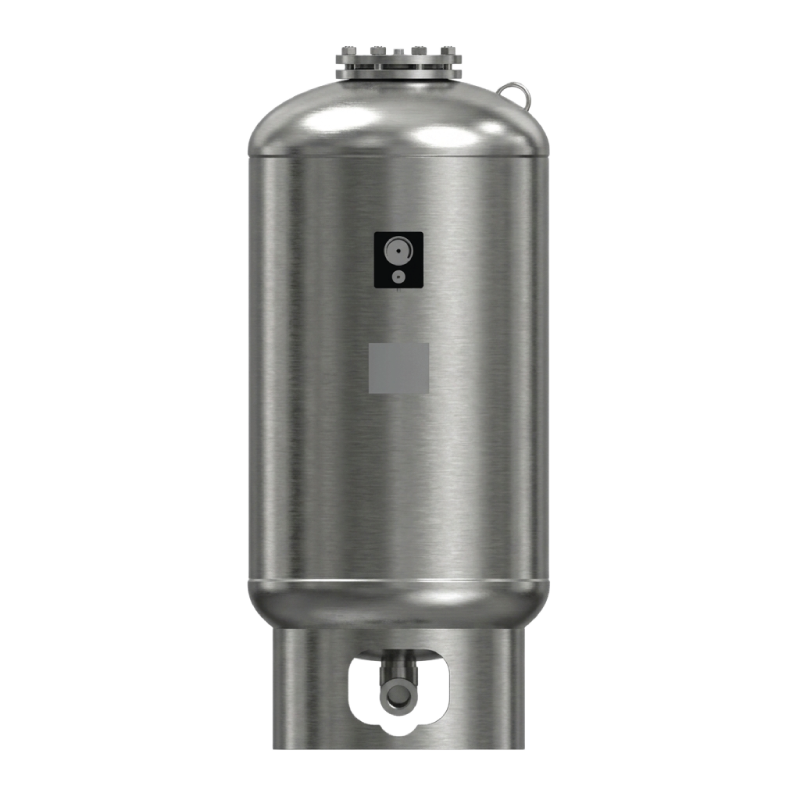
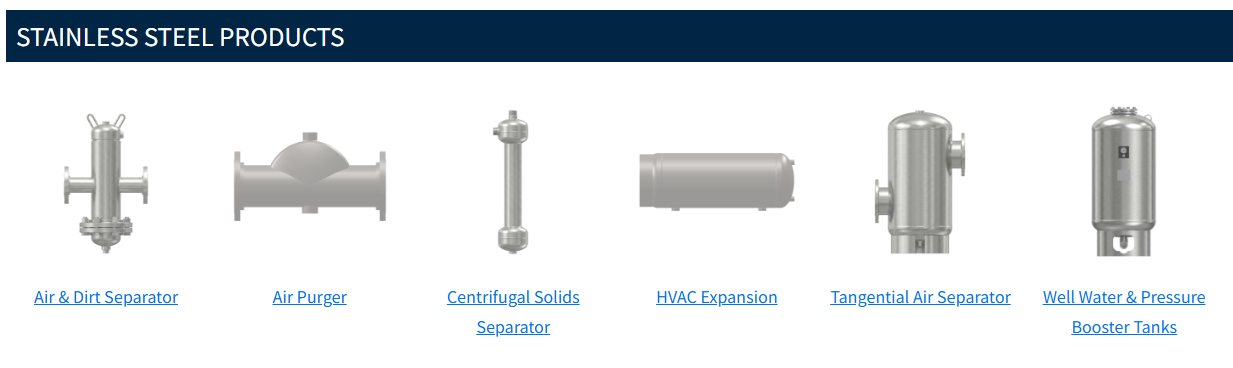
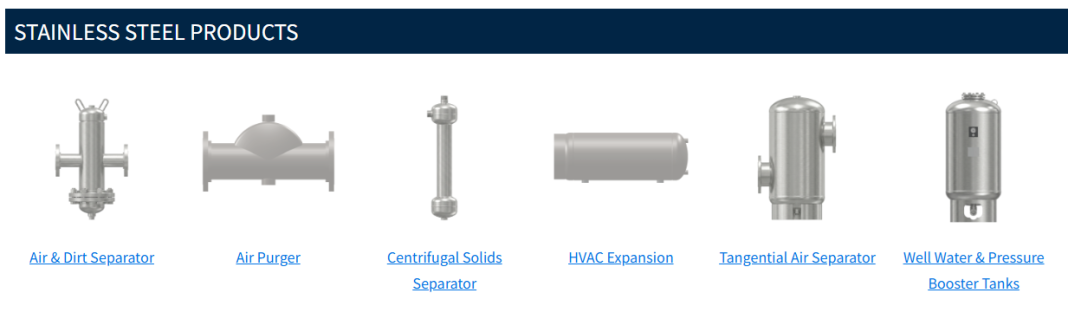
Wessels Company offers passivation options across our stainless-steel product lines, including expansion tanks, thermal energy storage vessels, and air-dirt separators. In addition, some sourcing partners offer ferrous-free facilities to prevent cross-contamination. For more information on custom stainless steel vessel options or to request a quote, visit westank.com or call our headquarters at 317-888-9800.

|
|
|
|
|

The proper way of setting the pre-charge air pressure for a tank in operation is to isolate the tank from the system, drain off all expanded fluid, and measure the air pressure in the tank. The pre-charge air pressure can then be reset to its optimal setting. Depending on the tank size, this process can take a lengthy amount of time. To reduce the service time on an operating tank, there are alternative techniques that can be used.
Fixing a system expansion tank quickly requires some basic understanding of its operation and the principles of compressed gas (air). The expansion tank absorbs the system’s expanded fluid caused by temperature increase. The tank air volume controls the pressure increases in the system. A very large, oversized tank will register a very low pressure increase because the relative air cushion volume change is small. A properly sized expansion tank should show a pressure increase of 20-40 psi from empty to “full” of expanded fluid.
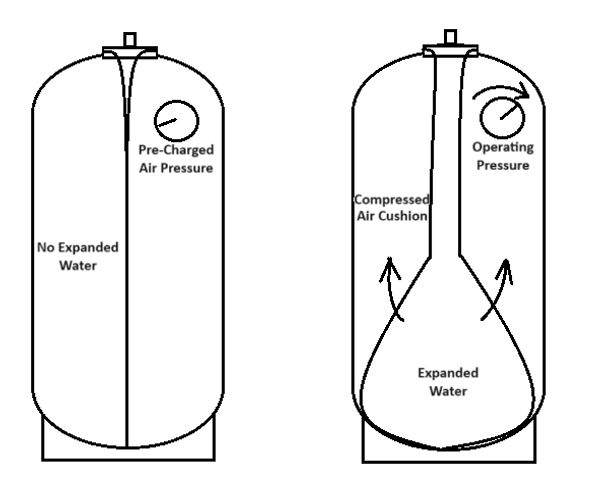
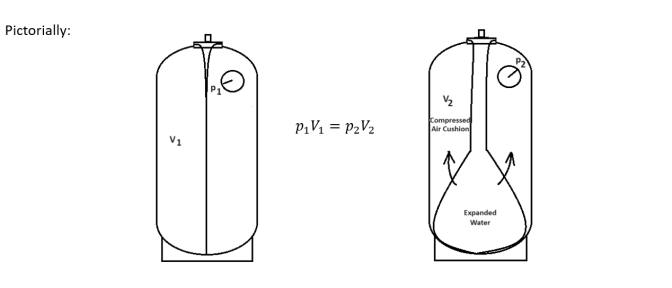
The air cushion in an expansion tank follows the principles of Boyle’s law. Boyle’s law states that pressure times volume of a contained gas equals a constant. If the compressed gas is pressurized to twice the starting pressure, the resulting volume of the compressed gas is 1/2 of the original volume. Simply stated, Boyle’s law is:
Air loss over time
Air or nitrogen gas can find its way out of the sealed tank. The points of minute air loss that may not be easily observed through standard bubble testing are threaded connections, the air charge valve, bulkhead fitting (bottom system connection on select tanks), and the bladder itself. The bladder is butyl, which has very low permeability. Higher pressure can drive more air through the bladder by means of diffusion. As the high-pressure water is “starved” for oxygen/air, it will pull molecules through the bladder over time.
As air is lost through the tank bladder or threaded connections, the result is the same as under-inflated air charge pressure. The tank will back fill with water until the air pressure in the tank equals the system water pressure. This will result in the same issues as an undersized expansion tank.
Annual Bladder Tank Check
Schedule a preventative maintenance event every 12 months. NOTE: there should be a drain valve between the system isolation valve and the tank. If one is not present, have one installed.
Setting the Pre-Charge “On-the-Fly”
With the tank in operation, a common question is “Can I adjust the pre-charge pressure in the tank without draining the tank first completely?” The answer to this question is “Yes,” providing we have working understanding of the compression air cushion of the expansion tank. As we approach the tank, we will notice that the tank is operating and the pressure P1. As we drain water from the isolated expansion tank and measure the captured water in a known volume bucket, a lower pressure P2 should be observed. Armed with these three data points, plus the size of the tank on the job, and the needed pre-charged pressure for the tank at startup, we can adjust the pressure P2 to ensure that, as the tank empties, it will ramp down to that required pre-charge pressure.
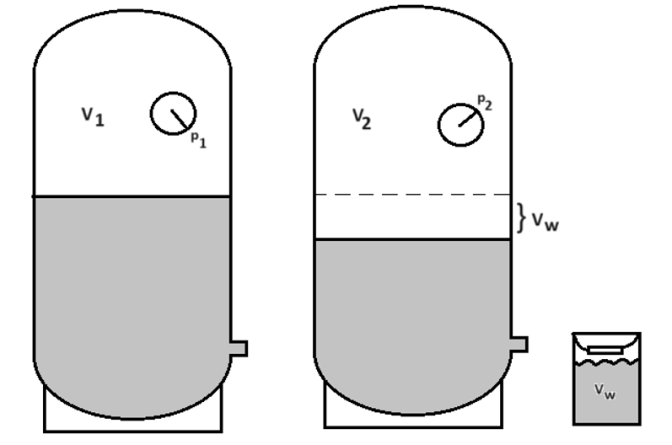
Let’s look at the variables needed to to be identified to set the pre-charge pressure with a somewhat full tank:
Vt Tank total volume in gallons.
Vw Water drawn from the operating expansion tank in gallons.
p1 Measured pressure before the water draw in psig.
p2 Measured pressure after the water draw in psig.
pa Atmospheric pressure (sea level typically 14.7 psia).
ppre Required tank pre-charge at system startup in psig.
With these known variables, we will calculate:
PE Potential energy needed in the tank in GAP (gallons absolute pressure in psia).
V1 Air volume of the operating expansion tank in gallons.
V2 Air volume of the expansion tank after the water draw in gallons.
The expansion tank can be thought of as a container of potential energy of (ppre + pa) x Vt at the startup of the system. Boyle’s law p1V1 = p2V2 means that this potential energy should remain the same at any condition of the tank. If we see that the potential energy has dropped, we can increase the air pressure in the tank until that potential energy is met.
We will first calculate the potential energy required by the tank’s air cushion, PE.
PE = (ppre + pa) x Tv
We will start with Boyle’s Law to help find V2 then adjust P2 to meet the required potential energy.
(p1 + pa)V1 = (p2 + pa)V2
As we draw off water, the resulting air cushion size relationship is:
V1 = V2-Vw (Vw is the known draw water volume)
Substituting shows:
(p1 + pa)(V2-Vw) = (p2 + pa)V2
Solving for V2:
V2 = Vw(p1 + pa)/(p1-p2)
Because we want the potential energy to match the tank’s empty condition, we solve:
(p2(new) + pa)V2 = PE
(p2(new) + pa) = PE/V2
p2(new) = PE/V2 – pa
Example: An NLA-800L (211 gallons) at the job site has a pressure reading of 60 psig. After isolating the tank and drawing off 8-gallons of water, the pressure reading drops to 52 psig. Atmospheric pressure is at sea level (pa = 14.7 psia). Find the required increase in pressure required after the draw of water to ensure the tank pre-charge pressure is 12 psig.
Vt Tank total volume 211 gallons
Vw Water drawn from the operating expansion tank 8 gallons.
p1 Measured pressure before the water draw 60 psig.
p2 Measured pressure after the water draw 52 psig.
pa Atmospheric pressure 14.7 psia.
ppre Required tank pre-charge at system startup 12 psig.
The potential energy at tank startup should be:
PE = (ppre+pa) x Vt
PE = (12+14.7) x 211 = 5,634 GAP (gallons absolute pressure in psia)
Solving for V2:
V2 = Vw(p1 + pa)/(p1-p2)
V2 = 8 (60 + 14.7)/(60-52)
V2 = 74.7 gallons
We can solve for the current potential energy in the air cushion V2 at pressure p2 of 52 psig and see that:
PE2 = (p2+pa) x V2
PE2 = (52+14.7) x 74.7 = 4,982 GAP (gallons absolute pressure in psia)
Now, determine the pressure p2(new) needed to bring the potential energy to the correct value of 5,634 GAP:
p2(new) = PE/V2 – pa
p2(new) = 5,634/74.7 – 14.7
p2(new) = 61 psig
It is important to reiterate that the best way to make sure the pre-charge pressure is correct is to drain the tank completely of any stored water and measure and adjust the pressure as needed. Often the method of drawing off a small amount of water will expedite the troubleshooting of an expansion tank at the job site. Regardless of findings and calculations, a tank should never be pressurized beyond the ASME working pressure of the tank. If calculations show that a high pressure is needed to reach the necessary potential energy, do not adjust if this could cause a dangerous or lethal situation. It is recommended that the entire tank be drained if this condition occurs.
Sam Fuller
Technical Engineer
Wessels Company
Download PDF Version of “How To: Quickly Adjust Vessel Pre-charge Pressure”

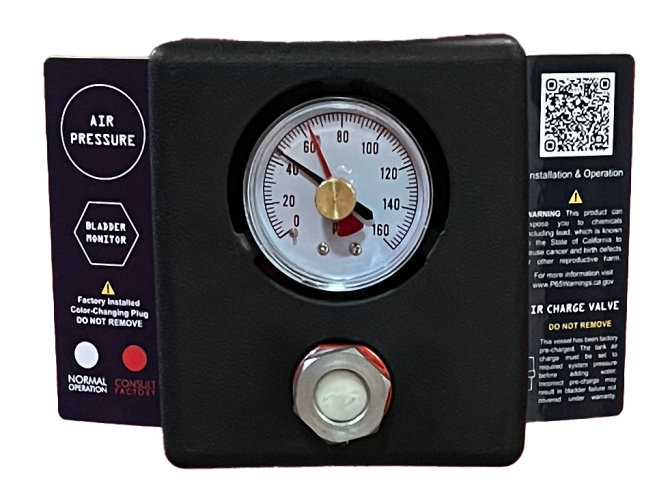 At times, an expansion tank pre-charge must be increased using compressed air. Wessels recommends dry, oil-free air like the compressed air used in our factory, which is taken to below -50°F and processed through a dryer. Another option is to use compressed nitrogen because it is an inert gas that avoids oxidation and moisture content that can corrode the system. Nitrogen also provides more consistent pressure and is readily available. But how many cylinders are needed to pre-charge a bladder tank to the desired pressure? There are several factors that need to be considered: the size of the compressed gas cylinders, the size of the expansion tank accepting the nitrogen, and the pressure that is needed for the pre-charge.
Additionally, we need to think in terms of stored potential energy. With the product pV (where p is absolute pressure and V is volume) equal to potential energy in joules (ft-lbf), we can calculate the energy in a cylinder of gas and compare it to the potential energy requirement of the bladder tank.
To make the units more conducive to gallons and psia, let’s use pV in terms of GAP (gallons times absolute pressure in psia). Gas cylinders are rated in cubic feet. This is actually the cubic feet of gas at 150 psig (164.7 psia) that, when released, would make up that amount of volume in cubic feet at 0 psia. In terms of potential energy in terms of GAP, the amount of energy in each cylinder is equal to 100 times the “rated” cubic feet of the cylinder. A 20 cubic foot cylinder charged to 2,200 psig yields a potential energy of 20 x 100 = 2,000 GAP.
Some common size cylinders whereas the rating in Cubic Feet based on 150 psig:
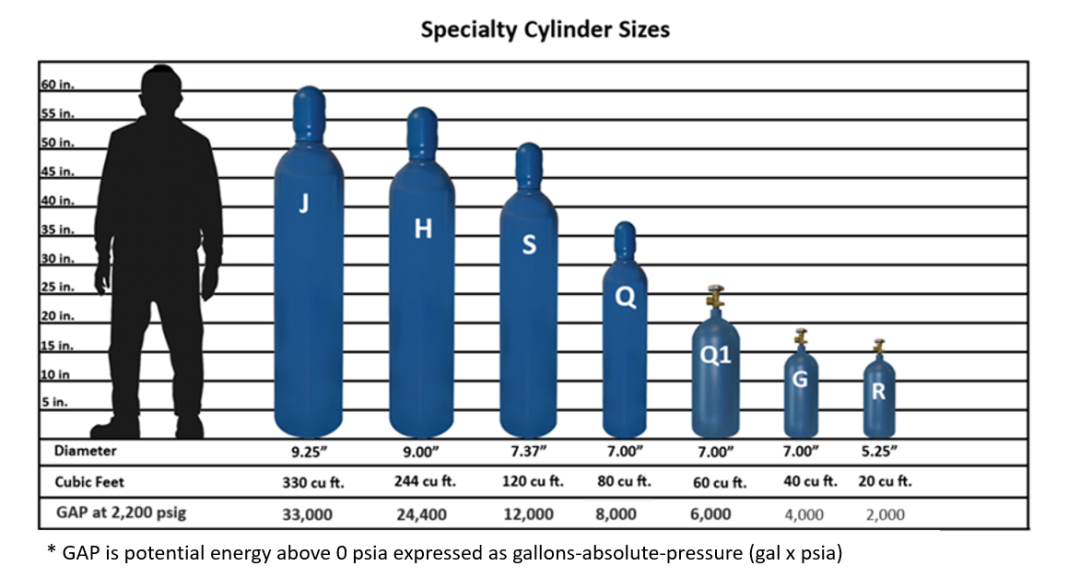
Be aware that the rating for the cylinders is referenced above 0 psia. If charging a tank to a pressure greater than 0 psia, which of course is any expansion tank, the potential energy will be somewhat less, but this will yield a close approximation. For example, if the tank at the job site is 250 gallons and needs to be charged from 40 psig to 90 psig, this requires the potential energy to be increased:
250 gallons × (90-40) psia=12,500 GAP
Bottle “H” is rated for 244 Cu.Ft. or 24,400 GAP above 0 psig. To recalculate the potential energy above 90 psig, a simple ratio should be used:
The 14.7 factor to convert psig to psia drops out of the equation and yields:
For the above example, the resulting cylinder potential energy above the 90-psig set point for the expansion tank calculates thusly:
The potential energy above 90 psig for the “J” 330 cu.ft. is 23,402 GAP and is large enough to handle the tank in this example. An alternative is to take two (2) “Q” tanks which also have the necessary GAP requirement for the example expansion tank.
An excel spreadsheet is available to download for evaluating most potential jobs.
 Written by:
Sam Fuller
Technical Sales Engineer
Wessels Company

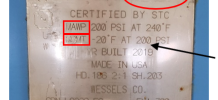
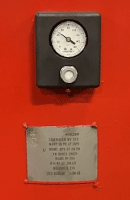 Every pressure vessel manufactured by Wessels Company is equipped with a metal data tag affixed to its front side, positioned below the smart bracket system. This data tag serves as a quick reference for essential vessel information.
All vessels that adhere to the ASME code have a corresponding U stamp on the tag. You can learn more about the ASME code and Wessels’s certification here: Wessels and ASME Specification | Wessels Company (westank.com)
Each vessel that adheres to the ASME code is also given a specific National Board number, which is the manufacturing organization’s sequential identifier for a specific pressure-retaining item so it can be tracked. The number circled is either a five- or six-digit number, found in the upper right corner of the data tag. Maintenance engineers can use the National Board number as a reference for technical support or warranty information.
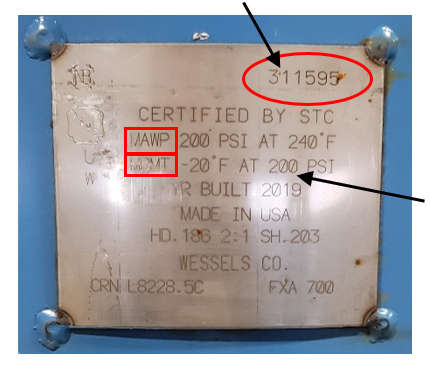
Crucial operational parameters such as maximum and minimum working pressures and temperatures are prominently featured on the tag. These values are denoted as Maximum Allowable Working Pressure (MAWP) and Minimum Design Metal Temperature (MDMT), respectively. For instance, the specified MAWP for this vessel is 200 pounds per square inch (psi), accompanied by a maximum working temperature of 240°F.
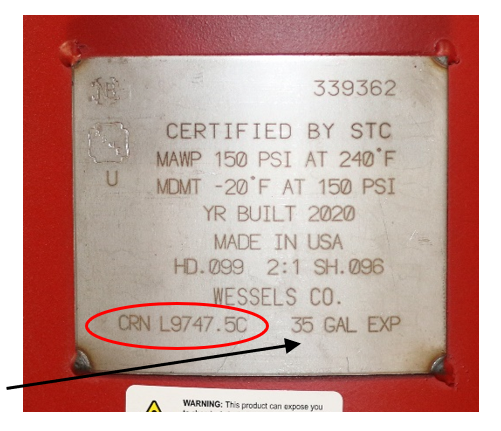 Additionally, the tag includes the manufacturing year, affirming its origin in the United States. H.D. denotes Head Dimension, indicating the size of the vessel’s top, while SH signifies the shell thickness or steel gauge employed in its construction.
In the lower left corner of the tag you can find the CRN (Canadian Registration Number), a mandatory identifier for vessels intended for installation and registration within Canada. Meanwhile, the tank type is often delineated on the lower right side; for example, this particular vessel is identified as a 35-gallon expansion tank.
The name of the manufacturer can also be found on the tag, and in this case, the manufacturer is Wessels Company. For more information about data tags, you can call our warehouse at 317-888-9800 or watch this short video.

We are pleased to introduce our new Operations Manager, Kevin Smith, who joined our team at the beginning of 2024. Kevin graduated from Indiana Wesleyan University in 2003 with an associate degree in Business Management. He highlights his coworkers as his favorite part of working at Wessels. Beyond his professional endeavors, Kevin pursues outdoor hobbies such as hiking, kayaking, and camping, alongside his passion for woodworking. He treasures quality time spent with loved ones, including his family, friends, and three rescue cats: Cuddles, Pokie, and Tiger. Kevin learned to play the card game Euchre when he was only 9 years old and has been playing in a monthly Euchre club for 30 years! Wessels extends a warm welcome to Kevin as he embarks on this new role.

Kevin fast facts:
Favorite color: Green
Favorite food: Tenderloin
Likes: Spending time with friends & family
Kevin Smith
Operations Manager
E-mail: [email protected]
Phone: 317-888-9800 ext: 1027

PRESS RELEASE
January 2024
Contact: Rebecca Bennett- Marketing Coordinator
[email protected]
317-888-9800
For Immediate Release
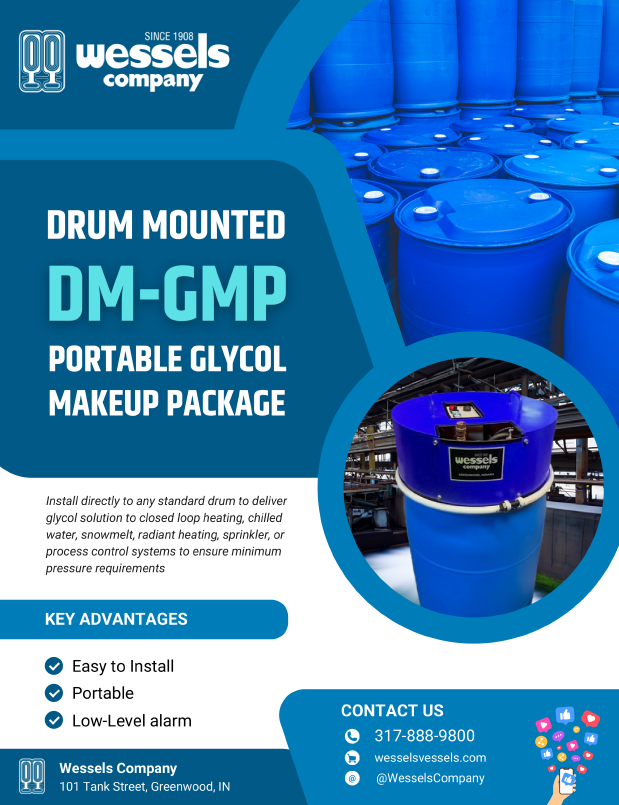
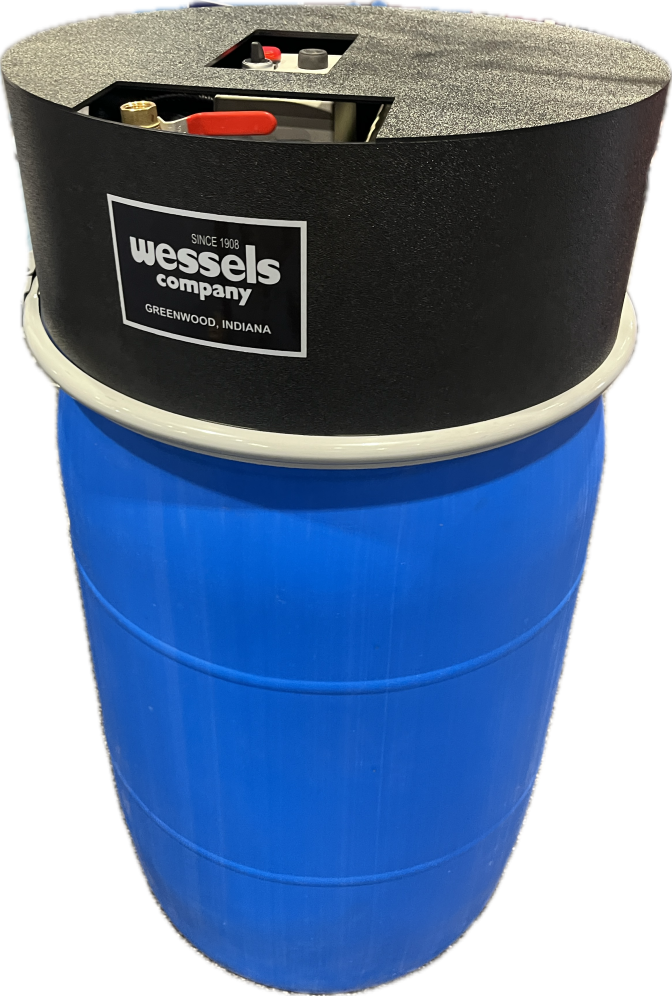 GREENWOOD, IND. – Wessels Company is thrilled to announce the debut of its latest product enhancements at the AHR Expo in Chicago, showcased at booth 6321. Among the highlights is the new Drum Mounted Glycol Makeup Package, known as DM-GMP, featuring enhanced mobility and refill capabilities. The system ingeniously mounts atop a standard drum containing glycol or glycol mixture, streamlining the refill and installation process.
The DM-GMP unit is designed to automatically supply a pressurized solution, such as glycol and water, to a closed loop heating, chilled water, snowmelt, radiant heating, sprinkler, or process control system to ensure minimum system pressure requirements are met. These systems are equipped with HOA controls, an adjustable pressure reducing valve (PRV), pressure gauge, and a low-level alarm that cuts power to the pump and actuates an audible and visual alarm when solution levels are too low.
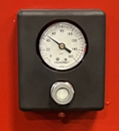 In addition to these advancements, the industry-leading smart bracket technology has undergone a redesign to be more compact and resilient. The WessView® bladder monitor, air pressure gauge, and Schrader valve have all been optimized to snugly fit the exterior of the tank with a single connection. The ASME tank and smart system seamlessly integrate all essential technologies into a convenient location. The new smart bracket will become a standard feature on all bladder-style tanks later this year.
For more information on the DM-GMP, download the new brochure and submittal.
About Wessels Company:
Wessels Company is a leading innovator in the design and manufacture of cutting-edge solutions for fluid control systems. With a commitment to excellence, Wessels continues to redefine industry standards through its dedication to quality, performance, and customer satisfaction. For more information, visit www.westank.com.

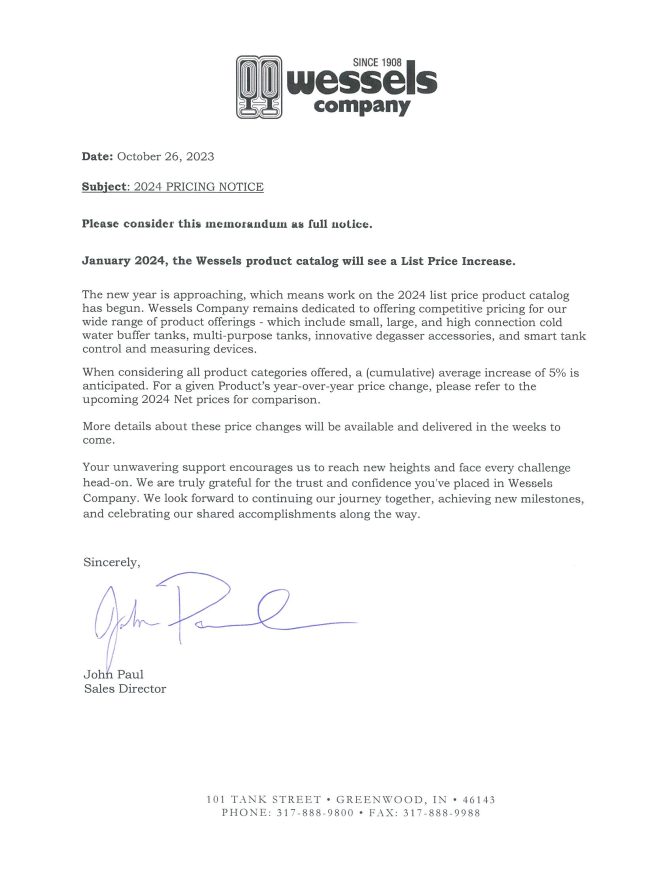
NOTICE: January 2024 List Prices will see a roughly 5% increase (cumulative)
The new year is approaching, which means work on the 2024 list price catalog has begun. Wessels Company remains dedicated to offering competitive pricing for our wide range of product offerings.
If you have not done so yet, we highly recommend ordering from our online platform wesselsvessels.com where you will receive a 3% discount to help offset the new price increases. Wesselsvessels.com is easy to use and was recently updated to include order status and tracking information. Learn more
Official Memorandum: