
Factory Closed for Inventory December 11th-13th
Please note, our factory will be closed for inventory next week, Monday – Wednesday, December 11th – 13th. We apologize for any inconvenience.
Our offices will remain open.


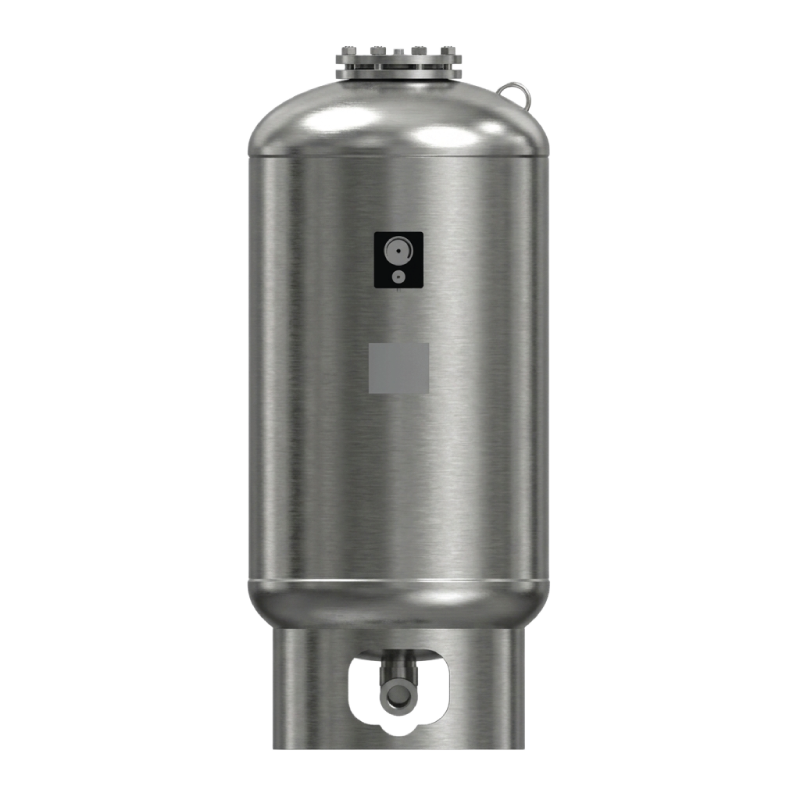
Rapid data center expansion and modern HVAC demands have led more engineers and specifiers to choose stainless steel vessels for their systems. But what exactly is passivation, and what makes a passivated stainless steel vessel desirable over traditional carbon steel?
What is Passivation?
Passivation is a multi-step chemical finishing process performed after components are manufactured, welded, and assembled. Its primary goal is to maximize the steel’s natural corrosion resistance.
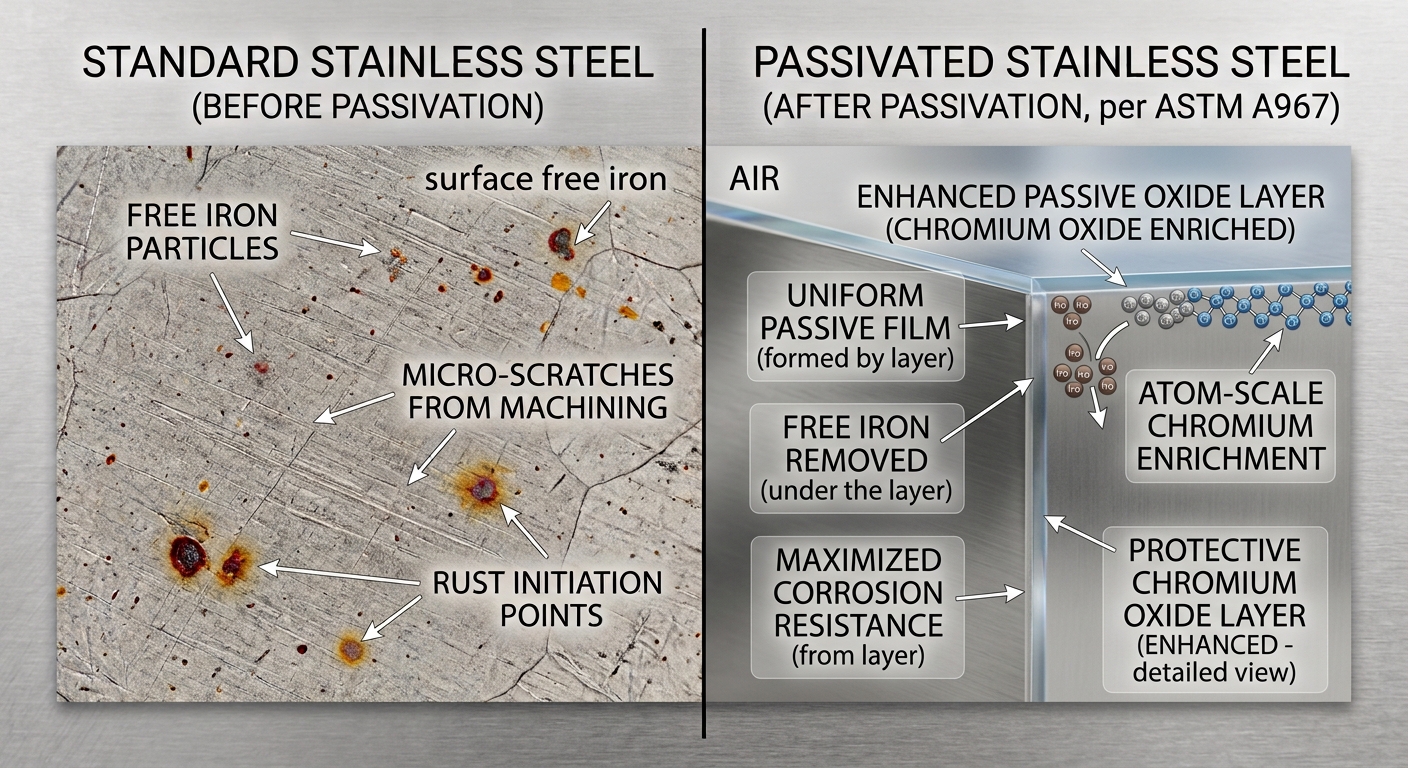
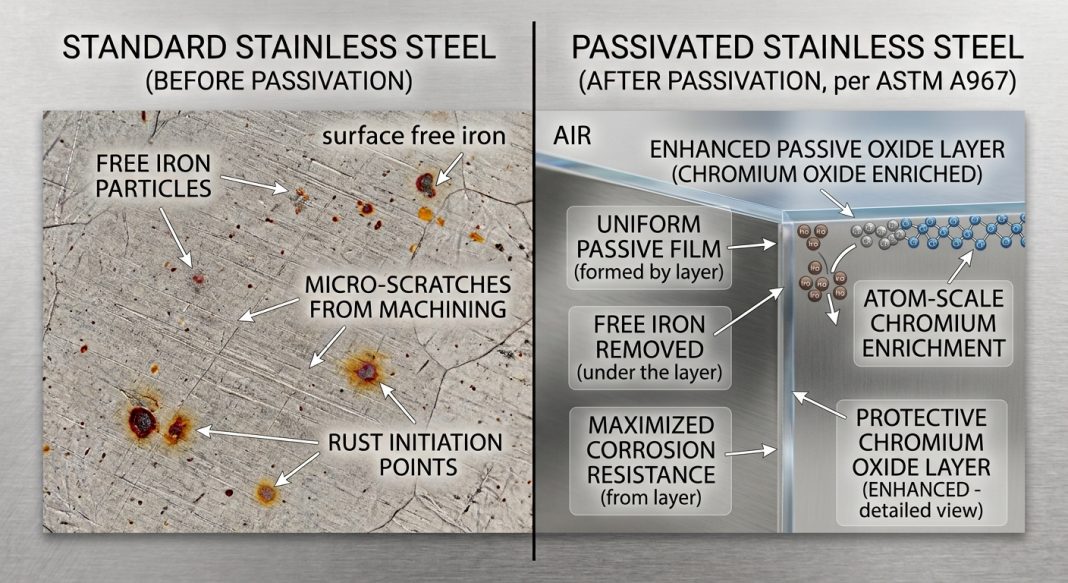
There is a common misconception that passivation physically fills surface flaws or mechanically alters the strength of the metal. In reality, it works chemically: during fabrication processes like cutting, machining, and welding, microscopic traces of free iron (tramp metal) from tooling get embedded into the steel’s surface. If left untreated, these iron particles react with air and moisture, triggering localized rust, pitting, and long-term surface deterioration.
Passivation removes these iron contaminants, allowing the stainless steel to protect itself as intended.
How Passivation Works: Building the Oxide Layer
Stainless steel owes its corrosion resistance to chromium ( of the alloy). When an acid bath selectively dissolves surface iron, it exposes an enriched concentration of chromium underneath.
Once rinsed and exposed to ambient air, this chromium rapidly reacts with oxygen to form an imperceptibly thin, continuous, and self-healing chromium oxide passive layer. This layer acts as a permanent barrier between the raw steel and the surrounding environment, keeping moisture and corrosive agents out.
Choosing the Acid Chemistry: Nitric vs. Citric
Passivation typically relies on one of two acid types:
The 4-Step Passivation Process
Achieving a true passive finish requires a tightly controlled sequence:
Why Passivation Is Exclusive to Stainless Steel
Passivation can only be performed on stainless steel and compatible high-chromium alloys. Carbon steel lacks the chromium required to build a protective oxide layer. If you submerge carbon steel into a passivating acid bath, the acid will aggressively etch and eat through the raw iron, weakening the vessel rather than protecting it. Carbon steel must instead rely on internal coatings, linings, or chemical system inhibitors for corrosion protection.
Stainless Steel Solutions from Wessels Company
By removing surface contaminants and enabling full passive oxide film growth, passivation ensures stainless steel vessels stand up to the most strenuous and harsh operating conditions.
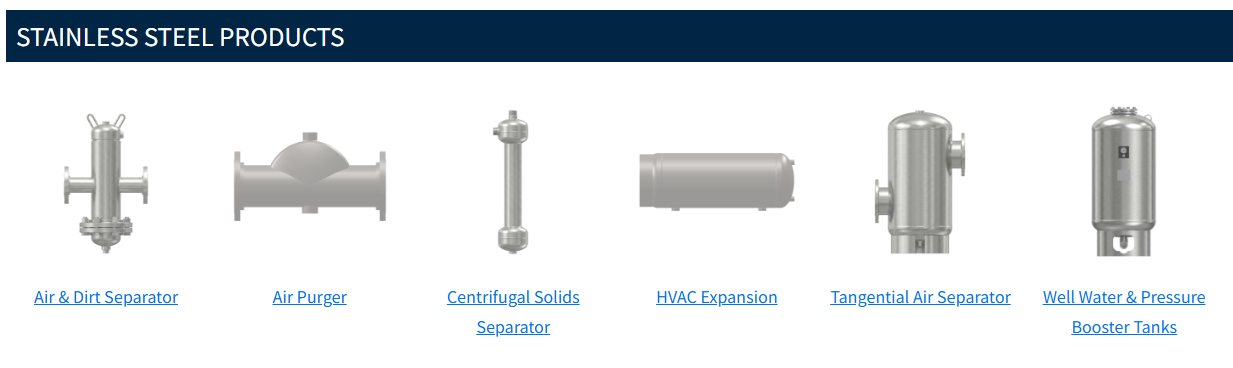
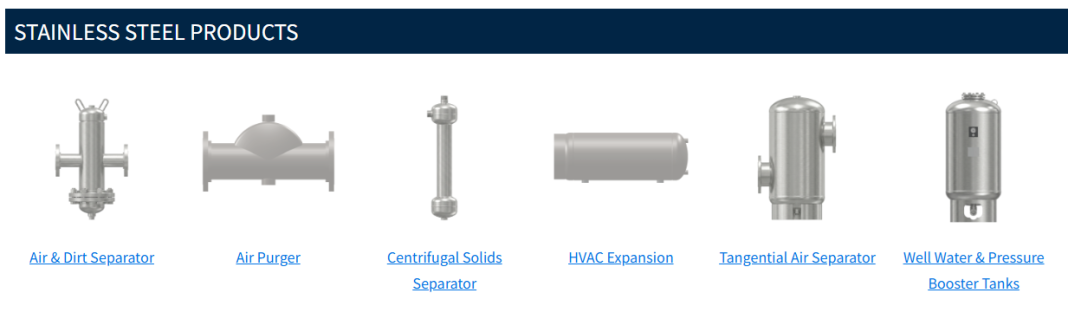
Wessels Company offers passivation options across our stainless-steel product lines, including expansion tanks, thermal energy storage vessels, and air-dirt separators. In addition, some sourcing partners offer ferrous-free facilities to prevent cross-contamination. For more information on custom stainless steel vessel options or to request a quote, visit westank.com or call our headquarters at 317-888-9800.

Please note, our factory will be closed for inventory next week, Monday – Wednesday, December 11th – 13th. We apologize for any inconvenience.
Our offices will remain open.

 We happily introduce the newest smiling face to the Wessels family, Allyson McQueen! She joined our engineering department at the beginning of November as a Process Engineer. She loves learning new things, which will surely benefit her in her new role on our engineering team. Allyson is an avid sports fan and has many teams she roots for including the Florida Gators, Atlanta Braves, Miami Dolphins, and the L.A. Lakers. She is a dog lover and has a large German Shepherd who she loves to spoil. In her free time, she can be found training large dogs and playing darts around the country in tournaments.
Allyson fast facts:
Favorite color: Orange
Favorite food: Smoked Brisket
Likes: motorcycle riding, sports, spending time with family

Wessels Company’s e-shop ordering platform WesselsVessels.com has gone live with its biggest update yet! Thanks to input from over 460 unique users from around the world, we’re excited to announce these new, highly requested features.
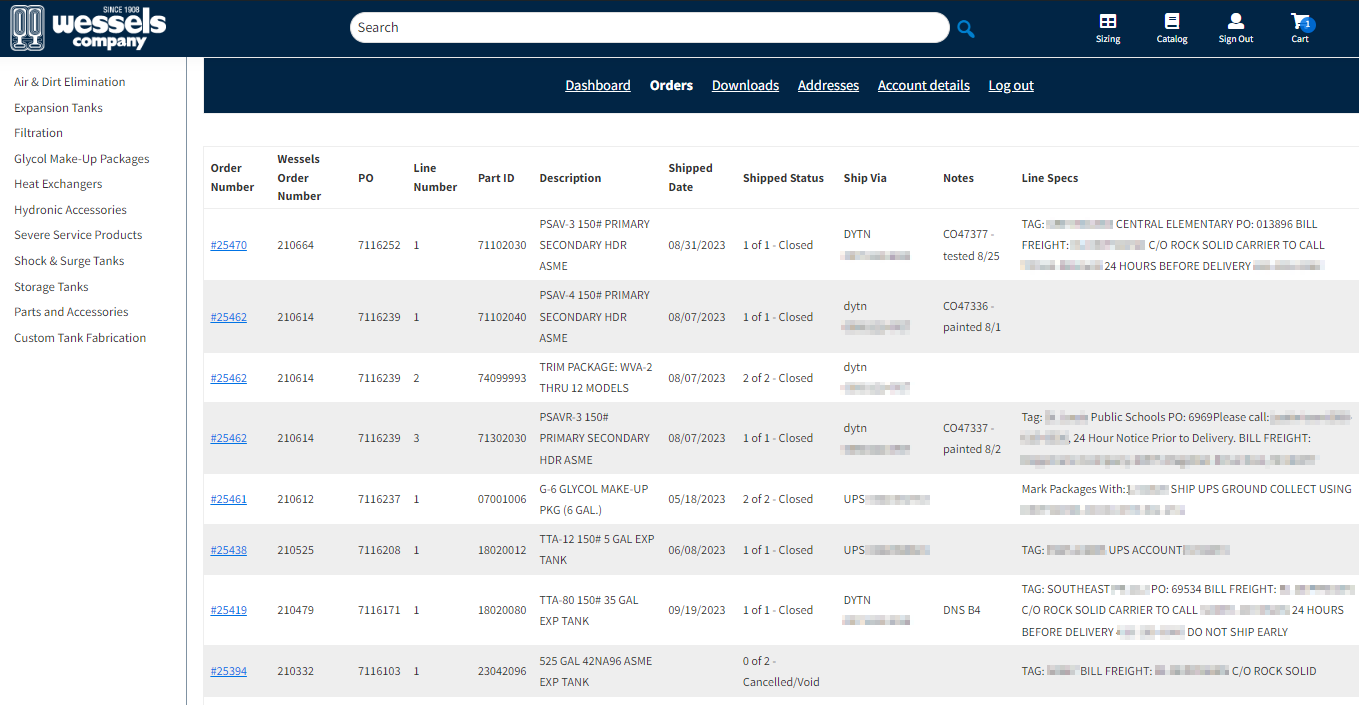
Now you can view your Wessels order number, your custom-entered purchase order number, order status, notes, and shipping information all on one screen by clicking the orders link on your account dashboard. To find the date of your order and order summary, click the blue order number link on the far left.

Admin accounts will be able to see all orders placed by users from their organization, while individual users will only see a history of their own orders. Please allow 1-2 business days for order information to populate after you’ve received your order acknowledgement.
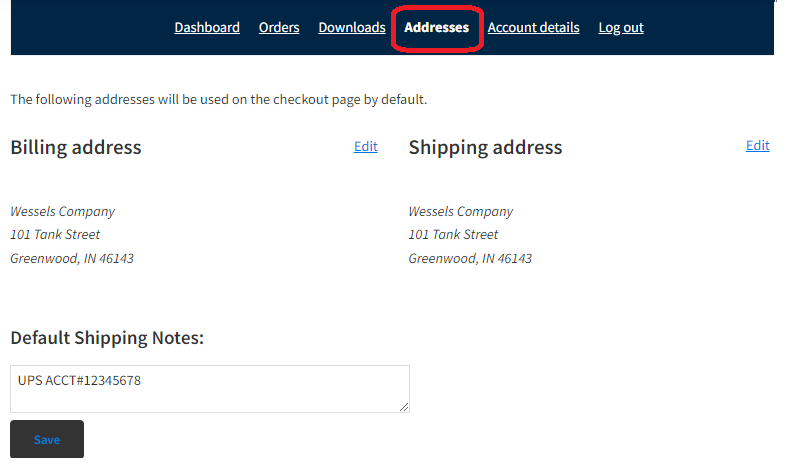
You can also now save custom shipping notes to your account by clicking the Addresses link on your acount dashboard. Add and save your information here and it will auto-load into all of your future orders. You can still change this during check-out, but if you find your shipping information rarely changes, you can save time by adding it here and having the system auto-fill the information for you.
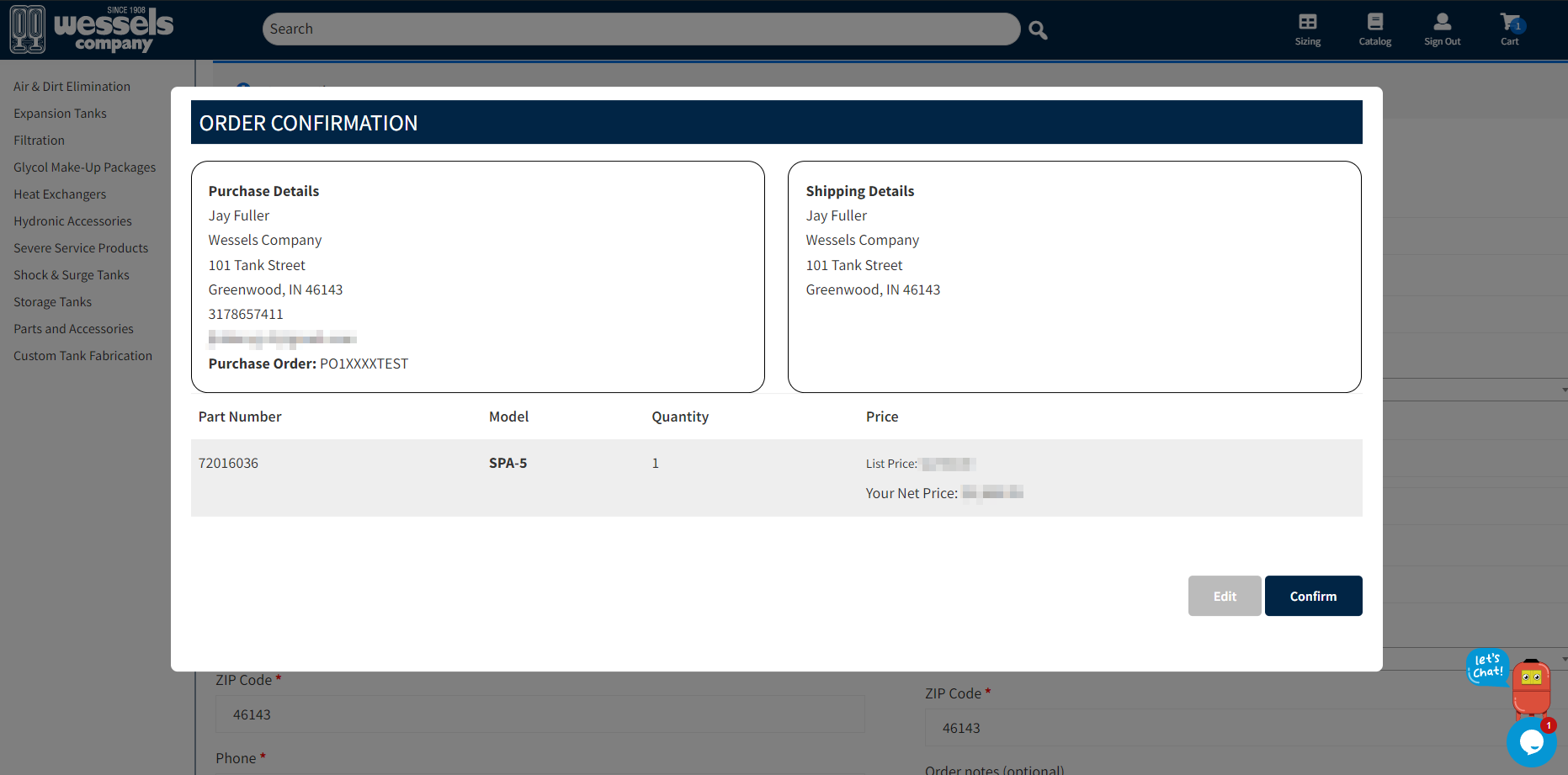
Finally, we’ve added an order confirmation page to give you one last chance to double-check your order information before submitting it to Wessels. Make sure everything looks correct, click confirm, and then you should receive an order processing email immediately. One of our customer service representatives will then follow-up with an order aknowledgement to finalize the order and release it for production.
Wessels is dedicated to continuing to improve our online ordering and tracking platform WesselsVessels.com. We’re currently working on optimzing both of our websites for mobile use and we’ve made a slew of small improvements, such as catalog style matching and updated menu systems, to improve functionality accross the board. We’re always looking for feedback and suggestions for future features. Have questions or some ideas on how we could improve? Please message us at [email protected] and let us know!

There are six critical inputs needed to size any expansion tank:
First, let’s define each one of these components. Amount of fluid is the gallons of system volume. This can be obtained either from the system drawings or estimated based on the size of the trunk main of the system and the dimensions of the building. Often, an accurate way to acquire this number is to ask a chemical treatment professional. They can dilute a trace chemical in the system and then measure that dilution, which can be used to extrapolate the system size.
 The type of fluid being heated is normally water or a mix of glycol and water. The specific volume of glycol increases with temperature faster than that of water. The difference between the specific volume at the starting and ending temperatures dictates the percentage increase in volume of the fluid. It should be noted that the piping system will also increase in size as it is heated. ASHRAE sizing, and most manufacturers, use a net expansion factor that accounts for the change in specific volumes less the expansion of the piping.
The starting and ending temperatures of the fluid depend on the type of system. For a heating system, the starting temperature is normally ambient, or 70 degrees Fahrenheit. The final temperature is typically your operating temperature, equal to the boiler set point. For a chilled water system, the starting temperature is normally the operating temperature or 30 to 40 degrees Fahrenheit. The final temperature of the chilled water system occurs if the system is allowed to go from operating temperature to ambient. The temperature used for tank sizing is typically 100 degrees Fahrenheit, which is the temperature of a very hot day for most areas.
 The minimum starting pressure for the tank depends on the height of the building above the expansion tank location. Starting with a penthouse installation, the pressure of the piping in the top floor installation needs to be 10 psi to ensure proper purging of the air that can collect at high points in the system. This means that the expansion tank located in a penthouse would be set for that same pressure, or 10 psi. As the tank moves downward in the system, an increase of 1 psi is needed for every 2.3 feet from the top. If the tank moves down 80 feet from the top, an additional 80 feet/2.3 feet per psi, or 35 psi more is added. The resulting charge for the tank is 35 psi plus 10 psi (needed at the top) or 45 psi.
The maximum ending pressure is normally set by the “weakest link” of the system. For example, if a boiler, heat exchanger, and air handler have maximum pressures of 100, 150, and 75 psi, respectively, you may be tempted to think the air handler is that “weakest link”. If, however, the air handler is at the top of the piping system, the pressure of a 65 psi increase from 10 psi to 75 psi is allowable. The boiler, if located at ground level where the pressure is 45 PSI to start, can only experience a 55 psi increase before it reaches its maximum rated pressure. A good practice is to allow the maximum pressure to increase by 25 to 35 psi over the initial starting pressure. Consider an operator watching the cycle of the HVAC system; if they observe an increase from 45 psi to 100 psi, they may consider that an abnormally high-pressure swing. Observing a pressure from 45 to 70 PSI is deemed in the eye of most operators as normal, as it does not approach the equipment’s maximum pressure.
The governing equation for sizing any expansion tank is:
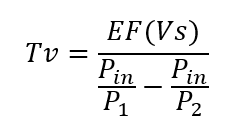
Tv=(EF(Vs))/(Pin/P1 -Pin/P2)
Where:
EF is the expansion factor that equals the percentage difference of the starting and ending specific volume of the fluid, minus the volumetric expansion of the system piping. Expansion factor tables are available from most manufacturers to make this calculation more convenient.
Once you know the tank volume (Tv) you need, you can cross-reference that number with the acceptance volume of expansion tanks in our PDF catalog or our online ordering catalog wesselsvessels.com
You can also download the Wessels Company phone apps or use you web-browser to access free-to-use sizing software by clicking “Size Your Tank Now”
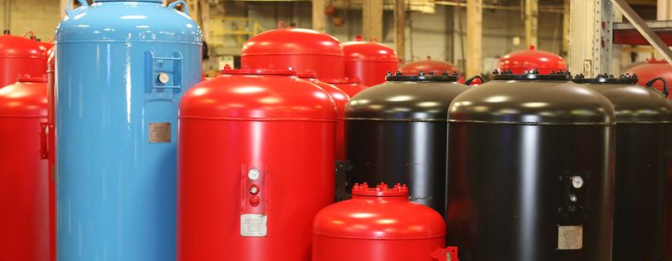

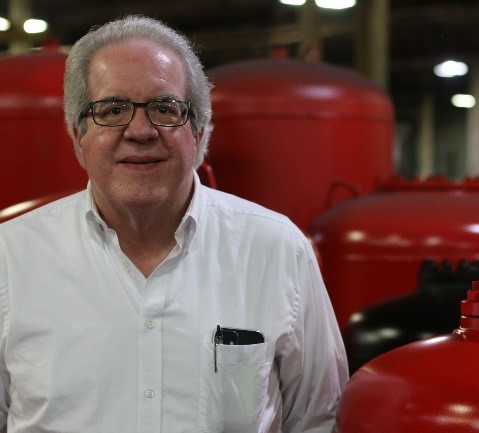 We are happy to introduce our newest employee, Gary Wilkinson, in the position of accounting manager. Gary graduated from Indiana University-Fort Wayne with a bachelor’s degree in accounting and Indiana Wesleyan University with a Master of Business Administration. His favorite part of his new position is working on a wide variety of projects. He also enjoys sports cars and watching auto racing. He was married for 42 years and has a daughter.
Gary fast facts:
Favorite color: Green
Favorite food: Stir-fry
Likes: auto racing, sports cars, and cool weather
Gary Wilkinson
Accounting Manager
e-mail: [email protected]
phone: 317-888-9800 ext: 1060

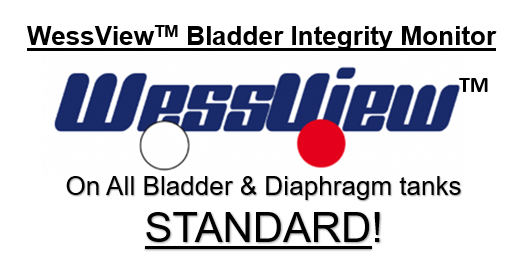
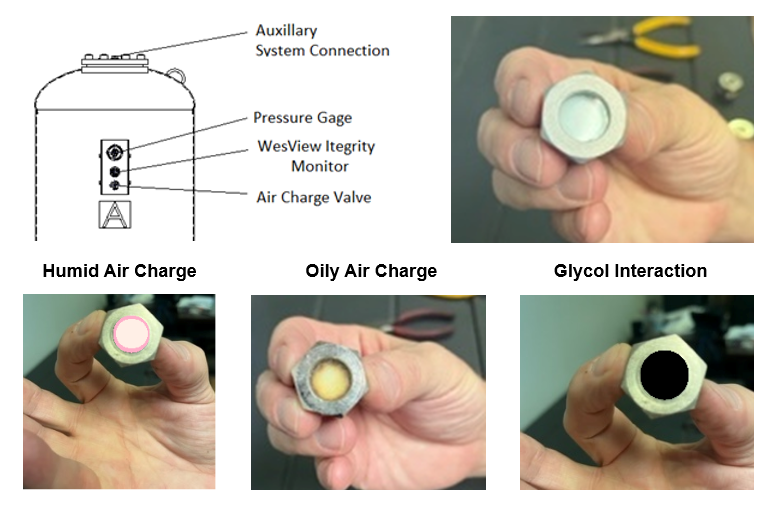
The WessViewTM bladder integrity monitor from Wessels Company is a quick, at-a-glance indicator letting you know if water has breached your tank’s internal bladder or diaphragm.
The design uses a desiccant that sits on top of a red disk. If the desiccant touches water and dissolves, the bright red disk will start to show. If the tank is charged with an air compressor in the field, the desiccant can turn pink, yellow, brown, or black if the air is moist or contaminated with oil or glycol.
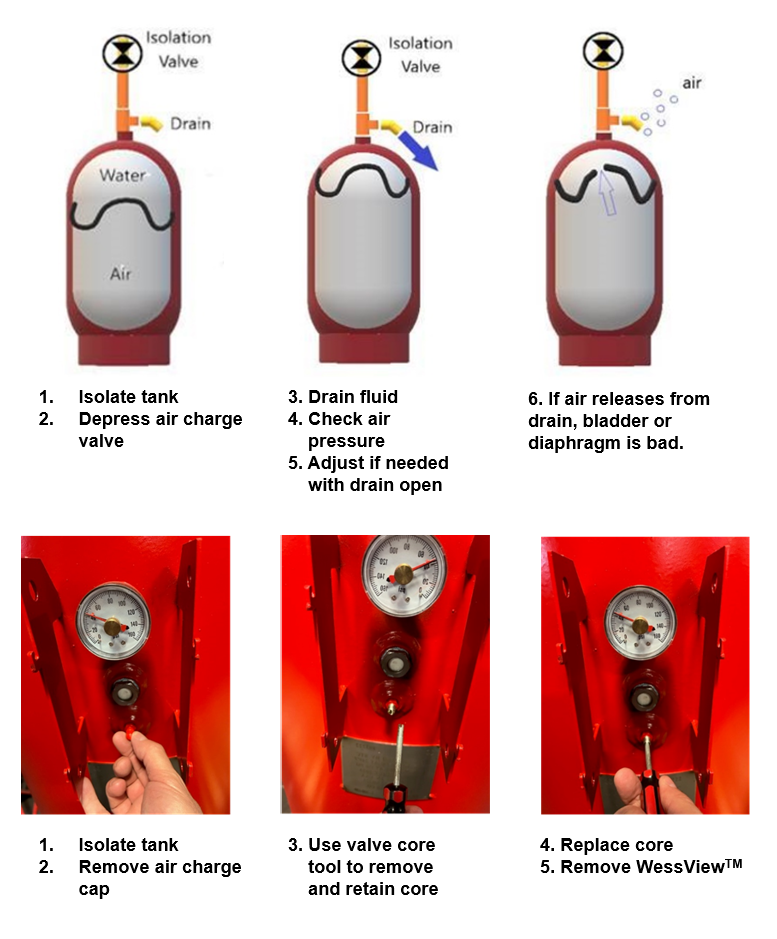
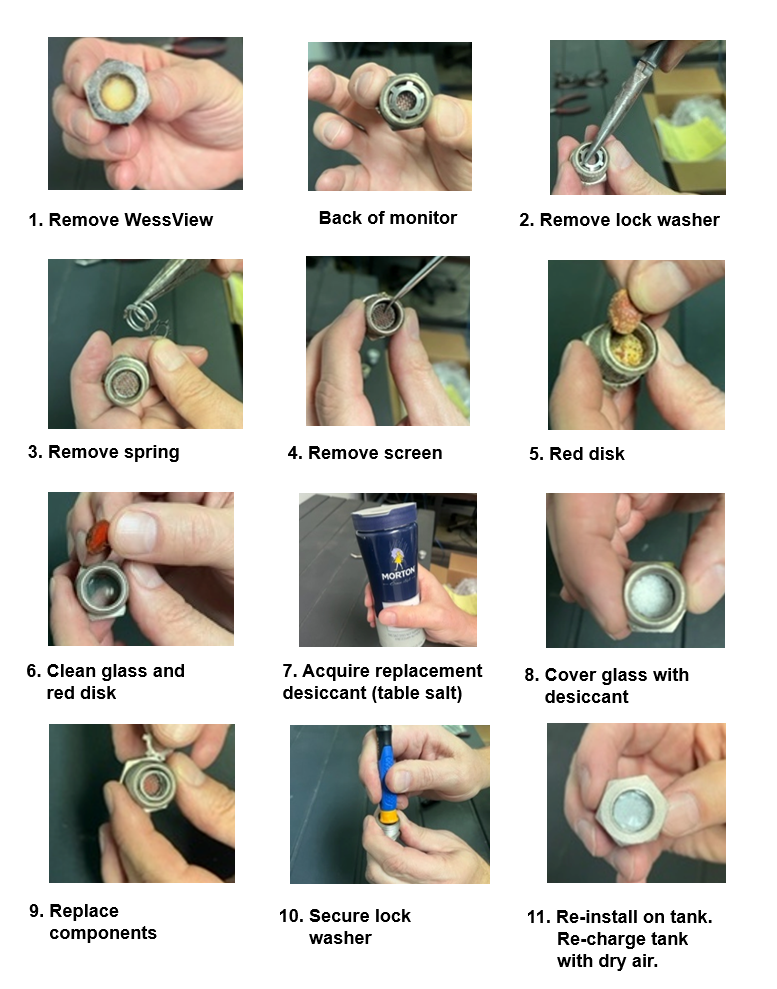
The WessViewTM is replaceable. If you need to replace your WessViewTM, you must make sure you release air pressure from the tank beforehand.
WARNING! Release air pressure from the tank before replacing WessViewTM. Failure to remove air may lead to serious injury or death.
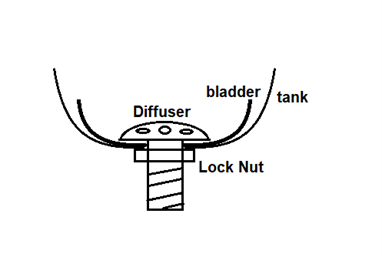
Expansion tanks sometimes develop air, liquid, or weeping water leaks at the bottom system connection (BSC). The BSC is a bulkhead fitting the goes through the tank bladder and compresses the bladder to the bottom tank head with the tightening of a jam or lock nut. The locknut is the sealing force between the tank head and the internal bulkhead threaded connection.
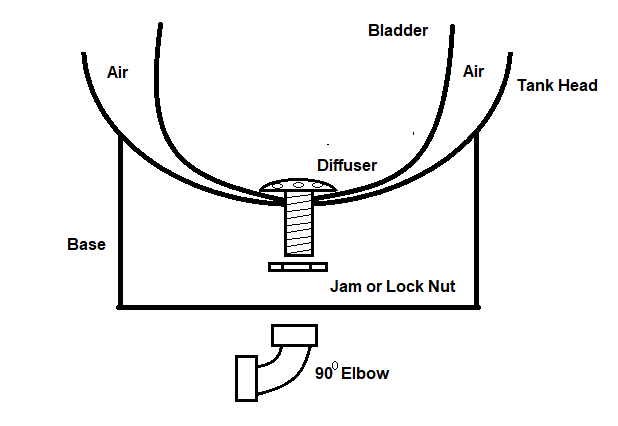
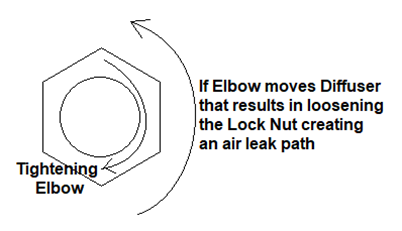
The elbow is tightened to the NPT threads of the diffuser. If there is torque created by piping into the elbow, this can cause misalignment and a subsequent air or water leak. To test the tank, first remove the potential torque.
1. Isolate tank from system.
2. Drain water from bladder (ideally there is a drain between the shutoff and the tank.)
3. Break the union to the tank (again, ideally between shut off and tank).
4. Charge air pressure to required pre-charge.
5. Apply soapy solution on lock nut. Tighten until there are no air bubbles.
6. Place piping into union to reintroduce torque (if there was any to begin with).
7. Apply soapy solution to lock nut again. Tighten until there are no air bubbles.
8. Service tank back into operation.
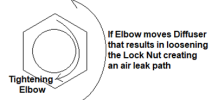
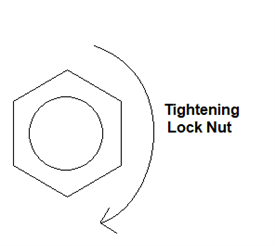
The tightening of the lock nut is in a normal clockwise manner that draws the diffuser down to compress the bladder. The elbow is then threaded to the NPT threads of the diffuser. If the elbow and diffuser spin freely, it has the same effect as loosening up the lock nut. This loosening will result in loss of air charge. The lock nut will require retightening to 60-70 ft-lbs. to re-establish the seal.

On behalf of Wessels Company, we regret to announce the sudden passing of our friend and colleague Douglas H. Fritts. Our deepest condolences and sympathy go out to his family and to everyone who had the opportunity to know and work with Doug. As a design engineer and draftsman, he helped shape our core products and was often the first one in the office, but never the first one out. He is survived by his four children, Christian (18), Joseph (14), Jake (9), and Carter (7), whom he loved. Doug was a source of energy and inspiration and will be deeply missed.
Jim Fuller, President, remembers Doug as “an inspiration to us all with his unparalleled work ethic, dependability, and productivity. He had a great sense of humor that helped greatly with the morale of the office. His passion for his children demonstrated his boundless family values. He also had a creative hobby selling and gifting handmade survival items. His presence at Wessels will be truly missed.”
Doug’s supervisor and Director of Engineering and Quality, Aaron Johannigman, recalls, “Doug has always been a team player and very dedicated to his work. He was always very creative with paracord, making all kinds of things from spinners to tackle equipment, hunting equipment, and personal defense items, and he took pride in his creations. He was a great guy and will be greatly missed by everyone who knew him.”
Visitation will be held on Tuesday, May 9, 2023, from 10am-12pm and Mass at 12pm at St. Cecilia Church located at 334 15th Street SW, DeMotte, IN with Father Michael McKinney officiating. In Lieu of flowers please consider a donation to the family to help with his children.
For more information about how you can provide support, please visit:
Frazier Funeral Home Douglas Fritts Memorial